

High-Strength Steel Roll Forming: What Machine Buyers Need to Consider
High-Strength Steel Roll Forming: What Machine Buyers Need to Consider
High-strength steels are increasingly specified for structural profiles where manufacturers want greater load capacity without simply increasing material thickness. Solar mounting channels, storage-rack uprights, structural sections, automotive components and selected building profiles are typical examples.
For a roll forming machine buyer, however, changing from conventional mild steel to HSLA or another high-yield-strength grade is not merely a material substitution. It can change the forming strategy, tooling geometry, drive requirement, shaft loading and even the appropriate number of forming stations.
This distinction is becoming more relevant as steel specifications continue to evolve. ASTM A1008/A1008M-26, published in 2026, covers several cold-rolled structural and high-strength steel designations, including HSLAS and HSLAS-F grades. ASTM A1011/A1011M-25 similarly covers hot-rolled structural, HSLA and ultra-high-strength sheet and strip.
For manufacturers investing in new roll forming machine for HSLA steel, the practical question is therefore not simply, “What thickness can the machine form?” It is: “What combination of thickness, yield strength, tensile strength and profile geometry has the machine actually been engineered to form?”
Table of Contents
Why Yield Strength Matters as Much as Thickness

Material thickness is one of the first parameters normally provided when specifying a roll forming line. It is important, but insufficient by itself.
Consider two coils of identical thickness. If one has substantially higher yield strength, the forces required to progressively bend it into the desired profile can be considerably different.
Higher-strength material generally increases resistance to permanent deformation. Depending on the profile, this may lead to:
- greater forming loads;
- increased springback;
- higher torque requirements;
- greater loads on shafts and bearings;
- increased sensitivity to tooling alignment;
- more demanding cutoff requirements.
This is why a machine quotation stating only a thickness range—for example, 1.5–3.0 mm—does not fully define the machine’s forming capability.
The material specification and mechanical properties should be supplied together with the profile drawing.
Springback Becomes a Critical Tooling Issue
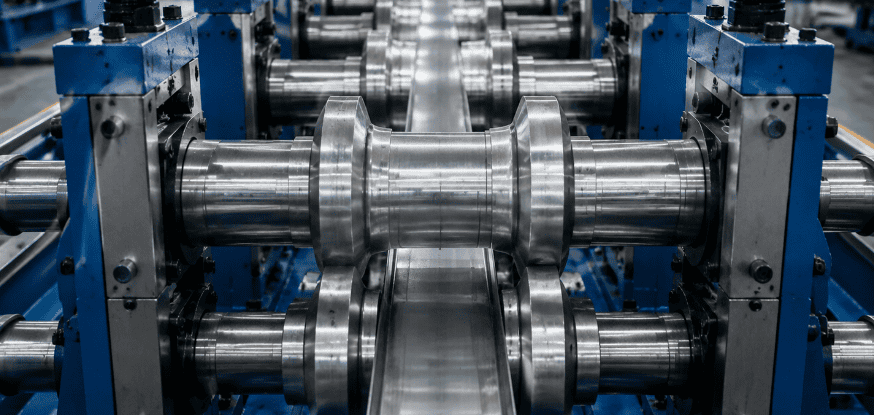
After steel passes through a forming station, elastic recovery causes the material to move slightly back toward its original geometry. This phenomenon is known as springback.
As yield strength increases, roll forming springback generally becomes more significant and must be accounted for during tooling design.
Simply increasing roller pressure is not an engineering solution. The roll tooling must progressively distribute deformation through an appropriate forming sequence.
Depending on the section geometry and material, engineers may need to adjust:
Forming angles
Individual passes may require controlled over-forming so that the profile reaches the required angle after elastic recovery.
Number of forming stations
A profile that can be produced reliably in a certain number of stations using conventional steel may require additional forming stages when produced from higher-strength material.
Adding stations is not automatically better. The correct pass schedule depends on the profile geometry, material properties and required tolerances.
Roller geometry
The contact conditions between the strip and rolls affect strain distribution. Poorly designed tooling can concentrate deformation in particular areas and increase distortion or surface damage.
This is why roll forming tooling design should be based on the actual production material rather than only the finished cross-sectional dimensions.
Profile Geometry Can Be More Important Than Nominal Thickness

A simple open channel and a complex profile manufactured from the same material may require very different machine configurations.
Features that increase forming difficulty include:
- narrow return lips;
- deep channels;
- multiple bends located close together;
- asymmetric sections;
- large width-to-thickness ratios;
- perforations near bend zones;
- tight dimensional tolerances.
High-strength material magnifies many of these challenges.
For example, a solar mounting channel may contain inward-facing lips and regularly spaced holes. The engineering team must consider not only how the high-strength steel profiles are formed, but also how punching affects material flow and whether hole position changes during forming.
This creates a direct relationship between punching layout, tooling design and final dimensional accuracy.
For manufacturers evaluating equipment for this application, the existing Strut Channel Roll Forming Machine page can provide the application-level machine configuration, while this article explains the material-engineering considerations behind such a line.
Machine Structure and Transmission Need Adequate Reserve
Higher forming loads must ultimately be carried by the machine.
Important mechanical elements include the shafts, bearings, stands, transmission system, base structure and main drive.
Shaft diameter and bearing arrangement
Roll shafts must resist both torque and bending loads while maintaining tooling position. Excessive shaft deflection can affect profile dimensions and accelerate tooling wear.
Machine stands
Rigid forming stands help maintain roller alignment under load. Structural rigidity becomes particularly important when producing thicker or higher-strength structural sections.
Drive system
Gearbox and universal-joint transmission is frequently selected for demanding structural-profile applications because it can transmit substantial torque directly to the forming stations.
Chain transmission remains suitable for many lighter applications, but drive selection should follow the actual forming load rather than a generic machine specification.
The objective is not to install the largest possible motor. The complete drivetrain should be engineered as a system with sufficient operating margin for the specified material range.
Punching and Cutting Must Also Be Designed for the Material Grade
The high-strength steel roll forming mill is only one part of a complete production line.
When higher-strength steel is introduced, upstream punching and downstream cutting forces also change.
Punching systems must provide adequate tonnage while controlling hole accuracy and tool life. Punch and die clearance becomes particularly important because inappropriate clearance can increase burr formation and tooling wear.
The cutoff system presents a similar issue. A blade and hydraulic system selected for mild steel cannot automatically be assumed to perform identically on higher-strength material of the same thickness.
Cutting method also affects production strategy. Stop-to-cut hydraulic systems provide a relatively straightforward solution for many structural profiles, while a roll forming flying cut system can eliminate the need to stop the strip when higher continuous production speed is required.
The correct choice depends on profile geometry, production speed, cut quality and investment level—not simply the advertised maximum line speed.
Material Variation Should Be Considered Before FAT
One frequently overlooked issue is the difference between nominal material specifications and actual production coils.
ASTM A1008/A1008M-26 covers multiple cold-rolled structural and high-strength categories and specifies mechanical-property requirements. ASTM A1011/A1011M-25 covers hot-rolled steels extending from commercial grades through HSLA and ultra-high-strength classifications.
For roll forming projects, this makes the material certificate important engineering information.
Before tooling design is finalized, a supplier should ideally know:
- material standard;
- steel grade;
- minimum and maximum thickness;
- yield-strength range;
- tensile strength;
- coating specification where applicable;
- expected dimensional tolerances.
Trial material used during Factory Acceptance Testing should also be reasonably representative of the customer’s actual production material.
A high-strength steel roll forming machine successfully tested using easier-to-form material does not conclusively demonstrate performance with the customer’s highest-strength production coil.
Dimensional Accuracy Requires a Complete Process Approach
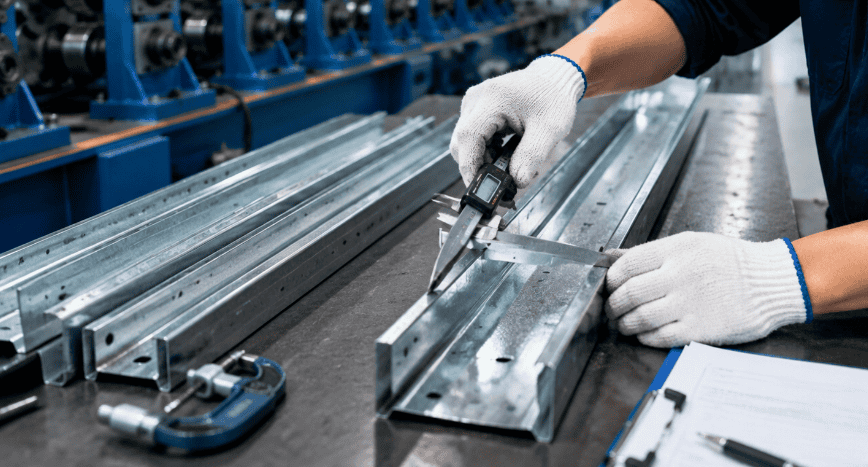
High-strength steel can also expose weaknesses elsewhere in the line.
If strip feeding is inconsistent, accumulated length error can affect punching and cutting positions. If the entry guide is incorrectly adjusted, the profile may gradually twist or move laterally. If roller alignment is poor, one side of an asymmetric section may develop differently from the other.
These issues explain why troubleshooting length inaccuracy in a roll forming machine should consider encoder measurement, feeding, acceleration/deceleration and cutoff synchronization rather than immediately blaming the forming rollers.
The same principle applies to profile accuracy: tooling, machine rigidity, material properties and setup parameters work together.
What Buyers Should Provide Before Requesting a Machine Proposal
For a high-strength steel roll forming project, a professional technical inquiry should contain more than a profile photograph.
At minimum, provide the supplier with:
- dimensioned profile drawing;
- material standard and grade;
- material thickness range;
- yield and tensile strength;
- coil or strip width;
- hole pattern and punching requirements;
- required product lengths;
- dimensional tolerances;
- target production speed;
- expected annual or shift production volume.
With this information, engineers can develop the roll flower, estimate forming loads, determine an appropriate station count, select the transmission and design the punching and cutting systems.
Do Not Select a Roll Forming Machine by Thickness Alone
A specification such as “0.8–2.0 mm galvanized steel” may appear precise, but from an engineering perspective it leaves several critical variables undefined.
Two machines advertised for the same thickness range can therefore have substantially different capabilities.
For structural profiles, buyers should evaluate the relationship between material strength, profile geometry and machine design.
Ask the supplier which material grade was used for engineering calculations and which material will be used during the acceptance test. Confirm the maximum specified yield strength—not just maximum thickness.
These questions are especially important when the production line may later be required to process stronger steels.
Understand What Shall be Really Considered
High-strength steel offers important opportunities for lighter and stronger structural profiles, but it also raises the engineering requirements of the roll forming process.
Successful high-strength steel roll forming depends on controlling springback, distributing deformation through an appropriate pass schedule, maintaining sufficient machine rigidity and torque, and correctly sizing the punching and cutoff systems.
For equipment buyers, specifying the steel grade and mechanical properties at the beginning of a project can prevent expensive tooling revisions later.
A well-engineered roll forming line should therefore be designed around the complete production envelope: profile geometry + thickness + material strength + tolerance + production rate.
That combination—not thickness alone—defines the real machine requirement.
Frequently Asked Questions
Potentially, yes, if the machine structure, drive system and tooling were designed for both materials. However, setup parameters and springback compensation may differ between grades.
Not always. Station count depends on profile geometry, thickness, bend distribution and material properties. Higher-strength steel can require a more gradual forming sequence, but tooling engineering should determine the final number.
High-strength steels can retain more elastic deformation during bending. After the material leaves the rolls, part of that deformation recovers, changing the final bend angle unless the tooling compensates for it.
Provide the material standard, grade, thickness range, yield strength, tensile strength, coating and strip width together with the dimensioned profile drawing.
Whenever practical, yes. Testing with representative production material provides much stronger evidence of actual machine and tooling performance than testing only with a lower-strength substitute.
