
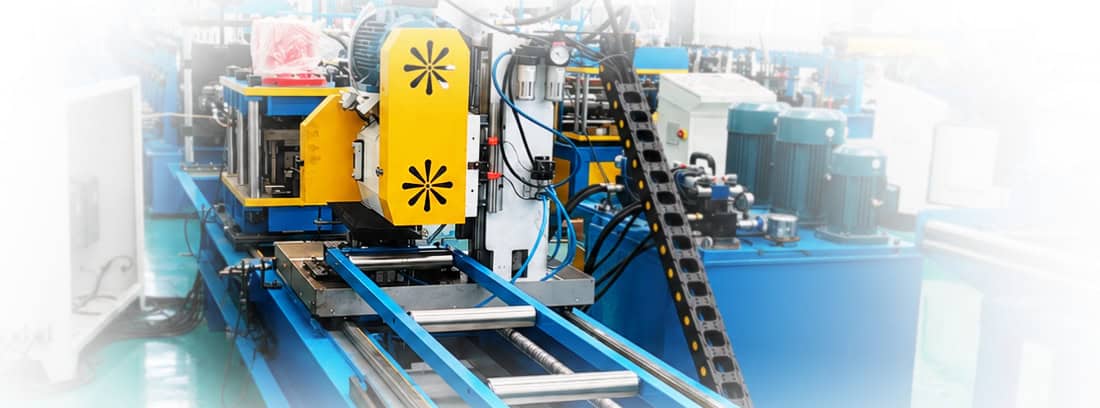
Why the Roll Forming Flying Cut System Is Gaining Ground in Profile Production
How Flying Cut Systems for Profile Production Perform During the Continuous Manufacturiing?
As production efficiency becomes a higher priority across the metal forming industry, manufacturers are evaluating every stage of the production line rather than focusing only on the forming section. While tooling design and forming accuracy remain critical, the cutting process increasingly determines whether a production line can maintain continuous operation without sacrificing dimensional consistency.
For many years, conventional stop-cut systems provided reliable performance for standard production speeds. Today, however, manufacturers producing roofing panels, structural sections, solar mounting rails, cable trays, and storage rack components are increasingly looking for continuous profile cutting solutions that allow production to continue without unnecessary interruptions.
Within modern metal profile production, the cutting system has become an important contributor to overall manufacturing stability rather than simply the final operation before profile collection.

Table of Contents
Continuous Movement Reduces Production Interruptions
Traditional hydraulic cut-off systems typically require the material to pause briefly while the cut is completed. Although this approach remains practical for many applications, repeated stopping and restarting may introduce unnecessary production delays during longer manufacturing runs.
Flying cut systems operate differently. The cutting carriage accelerates to match the profile speed, performs the cut while moving with the product, and then returns to its starting position before the next cutting cycle begins.
Because the profile continues moving throughout the operation, manufacturers can maintain more consistent production flow while reducing interruptions between individual lengths.
This approach is especially valuable for long roof panels, standing seam profiles, wall cladding panels, structural C and Z sections, and certain deck products where continuous production contributes to higher daily output.
Accurate Length Depends on More Than the Cutter
Length consistency is often associated with blade quality, but experienced production engineers recognize that several upstream systems contribute to cutting accuracy.
Stable material progression begins with the hydraulic decoiler and precision leveling section before reaching the servo feeding system. Encoder-controlled measurement continuously monitors strip movement so that the cutting carriage begins its synchronized motion at precisely the correct moment.
If feeding consistency varies, even the most advanced flying cut equipment cannot fully compensate for accumulated positional error.
For this reason, many manufacturers treat the production line as one coordinated process rather than a collection of independent machines. Reliable continuous profile cutting performance depends on communication between the feeding system, encoder, PLC, and cutting carriage throughout continuous operation.
These same principles are widely applied to cold roll forming lines producing solar mounting systems, drainage profiles, cable trays, and storage rack components.
Different Products Require Different Cutting Solutions

Not every profile benefits equally from the same cutting technology.
Light-gauge framing members and structural channels often perform well with hydraulic flying shear systems, while heavier structural profiles may require more robust mechanical arrangements depending on material thickness and production speed.
Roofing applications introduce another consideration. Long standing seam panels and snap lock profiles frequently require clean cutting without deforming narrow locking legs that are essential for installation quality.
Manufacturers therefore evaluate cutting solutions according to product geometry, steel grade, production speed, and downstream handling requirements rather than selecting equipment solely on maximum line speed.
For portable trailer-mounted and containerized production systems used to manufacture unlimited-length standing seam roofing panels directly at customer construction sites, simplified synchronized cutting arrangements help preserve mobility while maintaining continuous production.
Integrating Roll Forming Flying Cut Systems
The greatest benefit of flying cut technology is realized when it operates as part of a fully integrated production line.
A typical configuration may include:
- Hydraulic decoiler
- Precision leveling machine
- Servo feeding system
- Hydraulic punching station where required
- Roll forming machine
- Flying cut system
- Automatic stacking equipment
When these systems exchange operating data throughout production, manufacturers are better positioned to maintain profile alignment, stable length control, and smooth material flow during long production campaigns.
For manufacturers planning sustained production of specialized structural or architectural profiles, equipment suppliers may occasionally participate in cutting verification and production trials during tooling development. Such collaboration is generally appropriate for long-term manufacturing programs with consistent production demand rather than limited production orders.
Technical guidance published by the European Committee for Standardization (CEN) and the Fabricators & Manufacturers Association provides valuable reference material related to manufacturing automation, production equipment, and industrial fabrication practices.
As continuous production becomes increasingly important across multiple industries, Synchronized Profile Cutting systems are playing a larger role in maintaining Continuous Metal Profile Manufacturing efficiency without compromising profile quality.
Frequently Asked Questions
A flying cut system performs the cutting operation while moving at the same speed as the formed profile, allowing continuous metal profile manufacturing without stopping the material.
Standing seam roofing panels, wall cladding, C and Z profiles, solar mounting rails, cable trays, and many structural profiles benefit from flying cutting.
Its primary advantage is maintaining continuous production flow rather than increasing the speed of the roll forming process itself.
Servo feeding provides consistent strip progression, allowing encoder measurements and cutting synchronization to remain accurate.
Yes. Many trailer-mounted and containerized standing seam production systems use synchronized cutting solutions designed to maintain portability while producing unlimited-length roof panels.
Yes. Conventional hydraulic cut-off systems remain appropriate for many production lines where continuous high-speed operation is not the primary requirement.
