

Material Springback in Roll Forming: Effects on Accuracy and Control
How Material Springback Affects Roll Forming Accuracy and How to Control It
Material Springback in Roll Forming is one of the most important factors influencing profile accuracy and profile quality, dimensional consistency, and tooling design. As steel grades continue to evolve toward higher strength and thinner gauges, manufacturers must account for springback during both machine design and production setup.
If springback is not properly controlled, even a precision roll forming line may produce profiles that fail dimensional inspection or create assembly problems downstream. Understanding why springback occurs and how experienced manufacturers compensate for it is essential for achieving stable, repeatable production.
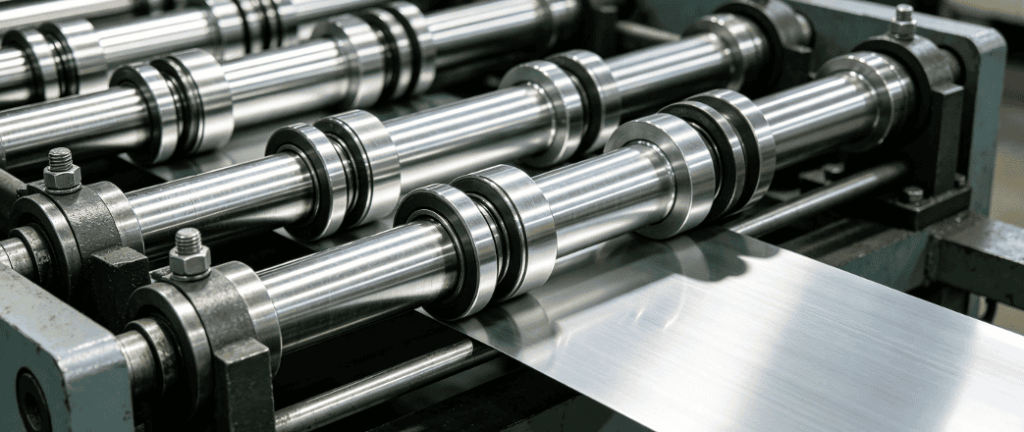
Table of Contents
What Is Material Springback in Roll Forming?
Springback is the elastic recovery of metal after it has been bent or formed.
During roll forming, steel passes through multiple forming stations where it is gradually bent into the required profile. After leaving each roller set, part of the elastic deformation is released, causing the material to “spring back” toward its original shape.
The amount of springback depends on several factors, including:
- Yield strength
- Tensile strength
- Material thickness
- Forming radius
- Material coating
- Profile geometry
Proper compensation for springback begins during roll tooling design rather than after production starts.
Why Springback Matters
Uncontrolled springback can lead to numerous manufacturing issues (Roll Forming Accuracy).
Typical problems include:
- Incorrect flange angles
- Out-of-tolerance dimensions
- Poor fit during assembly
- Uneven profile symmetry
- Gap variations
- Increased machine adjustment time
- Higher rejection rates
Manufacturers producing structural building components often work with strict dimensional tolerances, making springback control a critical part of quality assurance.
Companies investing in a Steel Purlin Roll Forming Machine frequently process high-strength galvanized steel, where springback is more pronounced than with conventional mild steel.
Which Materials Produce More Springback?
Not all materials behave the same during roll forming.
Generally, greater springback occurs when processing:
- High strength steel (HSS)
- Advanced high-strength steel (AHSS)
- Stainless steel
- Aluminum alloys
Lower-carbon mild steel usually exhibits less elastic recovery, making it easier to form.
As global construction standards increasingly favor stronger materials with reduced weight, springback compensation has become more important than ever. The elastic recovery of different steel grades varies significantly depending on their mechanical properties. For more information about high-strength steels, refer to high-strength steel material properties. More information about Advanced High-Strength Steel (AHSS) can be found on the American Iron and Steel Institute website.
How Engineers Control Springback
Experienced roll forming manufacturers consider springback during the initial tooling design phase instead of relying on repeated machine adjustments after installation.
Several engineering methods are commonly used.
Optimized Roll Tooling Design
Rollers are designed to slightly overbend the material so that after springback occurs, the final profile reaches the desired dimensions.
The amount of overbending depends on both the material properties and the required profile geometry.
Progressive Forming
Rather than applying excessive deformation in one station, high-quality tooling distributes the forming load across multiple roller stations.
This approach:
- Reduces internal stress
- Improves profile stability
- Produces smoother material flow
- Minimizes edge deformation
Production lines equipped with a Light Gauge Steel Framing Machine often require carefully engineered forming progression because light gauge structural profiles typically contain numerous bends and return flanges.
Material Testing
Many manufacturers request sample coils before finalizing tooling.
Testing the customer’s actual material allows engineers to verify:
- Mechanical properties
- Coating condition
- Surface finish
- Actual springback behavior
This reduces commissioning time after machine delivery.
Simulation Software
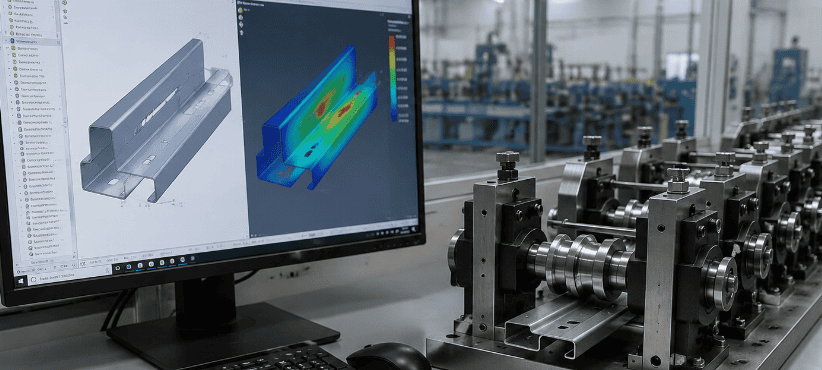
Modern engineering increasingly relies on digital simulation.
Using 3D CAD and finite element analysis (FEA), engineers can predict material behavior before manufacturing the tooling.
Simulation helps reduce development time while improving first-pass production accuracy.
Production Adjustments That Help Reduce Springback
Even with well-designed tooling, production parameters remain important.
Operators should monitor:
Material Consistency
Different coil suppliers may provide steel with slightly different mechanical properties.
Incoming material inspection helps maintain consistent production quality.
Roller Alignment
Misaligned rollers increase uneven forming forces and can amplify springback-related dimensional variation.
Forming Speed
Although springback is primarily a material property, excessive production speed may reduce forming stability on certain complex profiles.
Maintaining appropriate production parameters contributes to more consistent results.
Manufacturers using Custom Roll Forming Solutions often specify optimized process parameters for each profile family to ensure repeatable production across different material batches.
Common Misconceptions About Springback
Several misconceptions frequently appear during machine evaluation.
“More Roller Stations Always Eliminate Springback”
Additional stations improve forming progression but cannot eliminate the material’s natural elastic recovery.
“Every Steel Grade Behaves the Same”
Even materials with identical thicknesses may produce different springback depending on chemical composition and yield strength.
“Machine Adjustments Alone Solve the Problem”
Operator adjustments help fine-tune production, but proper tooling design remains the primary method for controlling springback.
Future Trends
As manufacturers process increasingly advanced materials, springback prediction continues to improve.
Current developments include:
- Digital twin simulation
- Material database integration
- Automated profile measurement
- Closed-loop production control
- Adaptive forming compensation
These technologies allow manufacturers to achieve higher dimensional accuracy while reducing setup time and material waste.
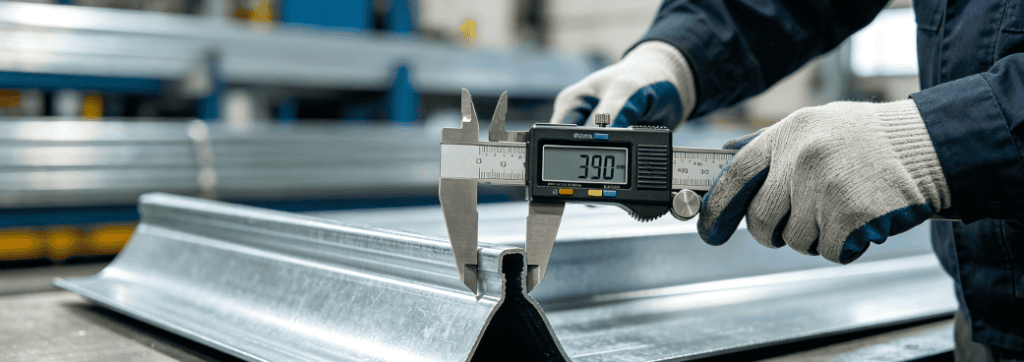
Material springback is an unavoidable characteristic of metal forming, but it can be accurately controlled through proper engineering. Well-designed roll tooling, progressive forming sequences, material testing, and digital simulation all contribute to producing high-quality profiles with consistent dimensions.
For manufacturers selecting new roll forming equipment, evaluating a supplier’s experience in springback compensation is just as important as comparing production speed or machine specifications.
Frequently Asked Questions
Springback occurs when metal elastically recovers after being bent, causing the profile to partially return toward its original shape.
High-strength steel, stainless steel, and aluminum generally produce greater springback than conventional mild steel.
No. Springback is a natural property of metal, but it can be accurately compensated for through proper tooling design and process control.
Yes. Material thickness, together with yield strength and bending radius, influences the amount of springback during forming.
Testing the customer’s actual material helps engineers optimize tooling design and reduce commissioning time by accurately compensating for real material behavior.
