
Pre-Punching vs Post-Punching in Roll Forming: Which System Should You Choose?
Pre-Punching vs Post-Punching in Roll Forming: Which System Should You Choose?
For many structural profile projects, punching in roll forming is not simply an optional accessory added to a standard machine. The location of the punching process can affect hole accuracy, production speed, roll tooling design, machine layout and ultimately the dimensional quality of the finished profile.
This becomes especially important for C/Z purlins, solar mounting channels, storage-rack uprights, cable trays and other roll formed products containing repetitive holes, slots or notches.
When evaluating a new roll forming production line, buyers commonly face two options: roll forming pre-punching, where holes are made while the strip is still flat, and roll forming post-punching, where the profile is punched after most or all forming operations have been completed.
Neither system is universally better. The correct solution depends on profile geometry, hole position, material properties, tolerance requirements and production rate.
Article Overview
What Is Pre-Punching in a Roll Forming Line?
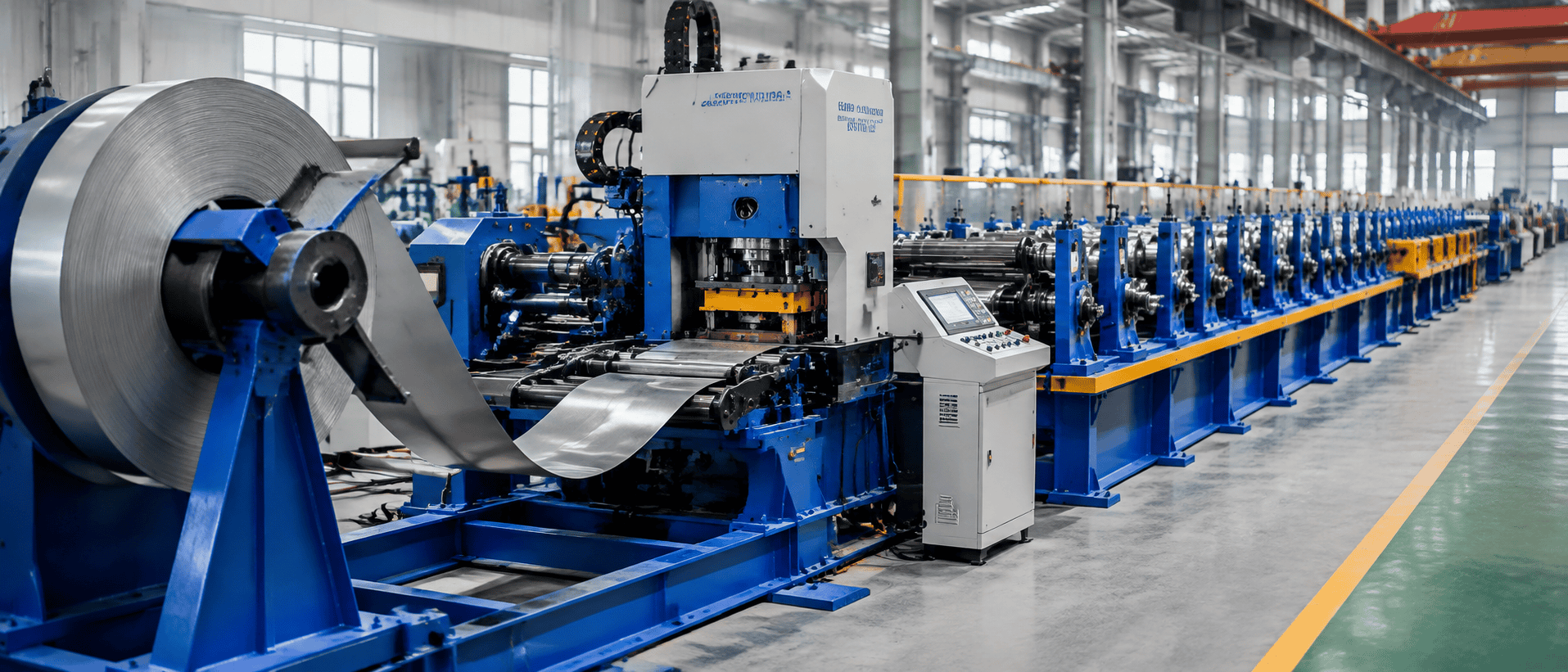
In a typical roll forming pre-punching configuration, the coil passes through the decoiler and leveling or servo feeding section before entering a punching press. Holes, slots and notches are punched while the material remains flat. The strip then enters the forming mill.
A typical process is:
Decoiler → Leveling → Servo Feeding → Punching → Roll Forming → Cutting → Run-Out
This configuration is widely used because flat material is easy to support and conventional punch-and-die tooling can approach the strip vertically.
For products with multiple connection holes, a programmable servo punching system can coordinate feed length and punch position through the PLC. Different hole patterns can therefore be programmed for different finished lengths without manually repositioning every punching tool.
The main engineering advantage is accessibility. Punching a flat strip generally requires simpler tooling than punching a three-dimensional formed section.
However, the hole must subsequently pass through the complete forming process.
That introduces the most important limitation of pre-punching: punched hole distortion.
Why Can Pre-Punched Holes Distort During Roll Forming?
Roll forming progressively bends a flat strip through multiple forming stations. The material does not simply move forward without deformation. Different areas of the strip experience different longitudinal and transverse strains during the forming sequence.
If a pre-punched hole or slot is positioned near a bend line, the surrounding material can stretch as the bend develops. A circular hole may become slightly oval, while a slot can change length or orientation.
Technical roll-forming guidance therefore consistently recommends keeping pre-punched holes and notches away from bend lines where possible. MP Metals
Research into perforated blanks also confirms that non-uniform longitudinal and transverse strains around perforations can contribute to warping during roll forming. Sage Journals
This does not mean that pre-punching is inaccurate.
In fact, properly engineered punching in roll forming can achieve excellent repeatability. The critical issue is understanding how the material will move after the hole has been punched.
Hole position relative to the bend
A hole located in a wide, relatively undeformed web is normally much easier to maintain than a hole positioned immediately beside a 90-degree bend.
Material strength
Higher-strength steels generally require greater forming forces and can exhibit different elastic recovery behavior. The forming sequence therefore needs to be considered together with the punching layout.
Hole and notch size
A small round hole has less influence on strip stiffness than a large notch removing a substantial part of the cross-section.
Large cutouts can locally weaken the strip during forming and may require a modified flower pattern or additional forming passes.
What Is Post-Punching?
With roll forming post-punching, the strip is formed first and the required holes are punched into the completed or nearly completed profile.
A simplified configuration may be:
Decoiler → Roll Forming → Servo Positioning → Punching → Cutting
The principal advantage is straightforward: the hole is produced after the cross-sectional geometry has already been established.
There is therefore little or no subsequent roll forming deformation available to change the hole shape.
For extremely demanding hole-to-profile positional tolerances, this can make post-punching in roll forming attractive.
But the mechanical problem becomes more complicated.
Instead of punching a flat strip, the tooling now needs to enter a three-dimensional profile. Sidewalls, return lips or closed sections can interfere with the punch and die.
The die must also adequately support the formed profile during punching.
This can increase tooling complexity considerably.
Pre-Punching vs Post-Punching: The Main Engineering Differences
For a machine buyer, the comparison should not be reduced to which system costs less.
The real decision involves several factors.
| Factor | Pre-Punching | Post-Punching |
|---|---|---|
| Tool accessibility | Excellent | Depends on profile |
| Punch tooling complexity | Usually lower | Usually higher |
| Risk of forming-related hole distortion | Higher | Lower |
| Punching flat material | Yes | No |
| Suitable for repetitive patterns | Excellent | Good |
| Very close hole-to-bend relationship | Requires engineering review | Often advantageous |
| Machine layout complexity | Moderate | Potentially higher |
| High-volume structural profiles | Very common | Application dependent |
This comparison is why a professional roll forming punching system should be designed from the finished product drawing rather than selected as a generic machine option.
Why Servo Feeding Matters for Hole Accuracy
Hole accuracy is not determined only by the punching die.
The feeding system is equally important.
In a programmable pre-punching line, the controller needs to know exactly how far the strip has advanced before each punching cycle. A servo feeder provides controlled material movement according to the programmed hole pattern.
Suppose a profile requires:
- two mounting holes near the leading end;
- repeated slots every 500 mm;
- an identification embossing;
- two final holes near the trailing end.
The PLC can divide the finished product into programmed punching positions. The servo punching system advances the material to each position and coordinates the press cycle.
This approach is especially valuable when the same production line manufactures several product lengths.
But cumulative feeding accuracy must still be considered.
If the material slips in the feeder, the encoder measurement is incorrect, or forming changes the effective strip length, hole position relative to the finished cut edge may deviate.
Therefore, roll forming hole accuracy is a system-level problem involving servo feeding, punching, forming and cutting.
Punching Before Forming for C/Z Purlins
Structural purlins provide a good example of why roll forming pre-punching remains popular.
Most connection holes are located in the relatively flat web of the C or Z profile rather than directly on the corner radius.
This makes the flat strip suitable for punching before it enters the forming stations.
For a programmable C/Z purlin roll forming machine line, the process can integrate:
Hydraulic Decoiler → Leveling → Servo Feeding → Hydraulic Punching → C/Z Roll Forming → Cutting
Different purlin lengths and hole patterns can then be entered through the control system.
Because the holes are primarily located in the web, the risk of severe punched hole distortion can be controlled through proper flower design and strip tracking.
This is considerably more practical than trying to insert conventional punching tooling into a fully formed C or Z section for every connection hole.
Solar Mounting Profiles Require More Careful Evaluation
Solar mounting channels can present a different engineering challenge.
Many solar profiles contain:
- dense slot patterns;
- inward return lips;
- small radii;
- relatively narrow webs;
- frequent punching operations.
The relationship between punching in roll forming and forming therefore becomes more important.
If slots remain in a flat central web throughout forming, pre-punching can provide excellent productivity.
But when punched features are located close to bends or in areas experiencing significant deformation, the roll tooling designer should evaluate how the hole will change through each forming station.
This is one reason why the product drawing should be supplied before the solar mounting frame roll forming machine configuration is finalized.
Storage-Rack Uprights: Punching Frequency Changes the Line Design
Racking uprights often contain very dense and repetitive perforation patterns.
The challenge is therefore not merely hole accuracy. It is punching capacity.
If a profile requires several holes every short pitch, the punching press may need to cycle many times for every meter of material.
A racking and shelving roll forming mill capable of 20 m/min does not automatically mean that the complete production line can produce perforated profiles continuously at 20 m/min.
The punching operation may become the production bottleneck.
Engineering options can include:
- multi-hole punching dies;
- multiple punching stations;
- higher-speed presses;
- optimized servo feed sequences;
- loop control between punching and forming;
- flying or continuous punching solutions for suitable patterns.
When comparing suppliers, buyers should therefore ask for the effective production speed with the required hole pattern, not only the maximum forming speed of the mill.
Cable Tray Production Introduces Another Variable
Perforated cable trays can require hundreds of openings within a relatively short length.
For these applications, punching may dominate the entire line architecture.
A complete production solution may combine decoiling, leveling, servo feeding, high-capacity punching, roll forming and cutting.
Depending on the perforation pattern and production target, a conventional hydraulic punch may not provide sufficient throughput.
This is why specifying only “20 m/min roll forming speed” can be misleading.
The correct question is:
How many finished perforated profiles can the complete cable tray roll forming line produce per minute or per shift?
That is the number that matters to the factory.
When Should Post-Punching Be Considered?
Roll forming post-punching deserves serious consideration when hole accuracy cannot reliably survive the forming process.
Typical situations include:
- holes extremely close to bend lines;
- holes positioned on formed surfaces;
- tight assembly tolerances referenced to the final profile;
- complex sections where longitudinal deformation affects pre-punched positions;
- secondary holes required after profile geometry has been established.
However, accessibility must always be checked.
A technically desirable post-punch location may be physically impossible if the finished profile prevents the punch or die from reaching the required surface.
The roll forming punching system must therefore be evaluated in three dimensions.
What Information Should Buyers Provide?
Before selecting a punching configuration, provide the machine supplier with:
- complete profile drawing;
- material grade and yield strength;
- minimum and maximum material thickness;
- coil or strip width;
- complete hole and slot pattern;
- hole-to-bend dimensions;
- finished product lengths;
- hole-position tolerances;
- cut-length tolerances;
- required production volume.
The supplier can then determine whether roll forming pre-punching, roll forming post-punching, or a combination is appropriate.
Sending only a profile cross-section without the punching drawing is insufficient for a reliable production-line proposal.
Do Not Treat Punching as an Accessory
For many modern structural profiles, punching is one of the defining processes of the complete roll forming line.
It influences machine length, control logic, servo feeding, production speed, tooling design and final profile accuracy.
Pre-punching remains highly effective for many high-volume products because flat-strip punching offers good accessibility and efficient tooling. Post-punching becomes valuable where the final profile geometry must define the hole position or where subsequent forming would cause unacceptable distortion.
The best solution is therefore determined by the product—not by a standard machine configuration.
When evaluating punching in roll forming, buyers should consider the entire manufacturing sequence:
material → leveling → feeding → punching → forming → cutting → finished tolerance.
That process-level approach produces a much more reliable machine specification than comparing press tonnage or advertised line speed alone.
Frequently Asked Questions
Is pre-punching or post-punching more accurate in roll forming? ›
Post-punching can eliminate deformation caused by subsequent forming, but that does not automatically make the complete process more accurate. Pre-punching combined with precise servo feeding and correctly designed roll tooling can achieve excellent repeatability when holes are located in suitable areas of the profile.
Can pre-punched holes change shape during roll forming? ›
Yes. Holes close to bend lines can experience deformation as the surrounding material is progressively formed. Industry design guidance recommends locating holes and notches away from bend zones whenever possible.
What controls hole-position accuracy on a roll forming line? ›
Servo feed accuracy, strip slip, punch tooling, encoder measurement, forming-induced strain and cutoff synchronization can all affect the final hole position.
Does adding punching reduce roll forming line speed? ›
It can. The effective production rate is determined by the slowest operation in the complete line. Profiles with dense perforation patterns may be limited by punching cycle time rather than forming-mill speed.
Can one roll forming line use both pre-punching and post-punching? ›
Yes. For complex profiles, different features can be produced at different stages when justified by geometry, tolerance and production requirements.
