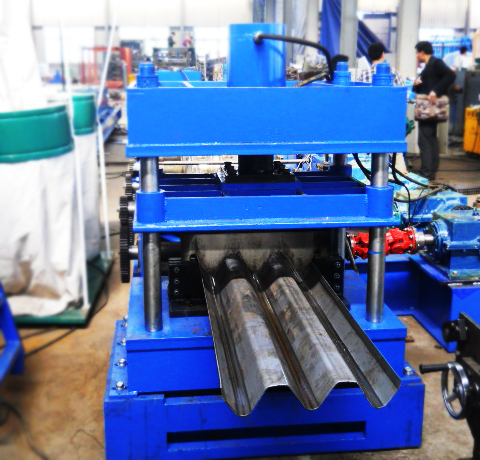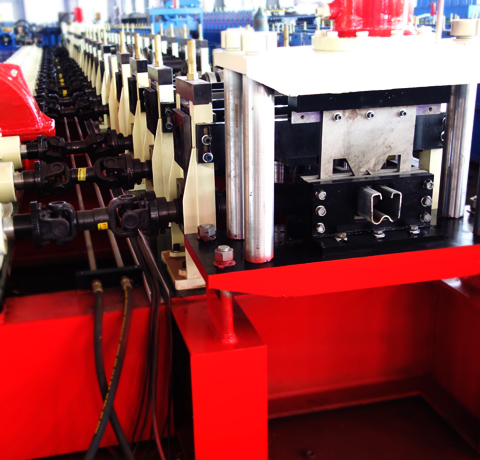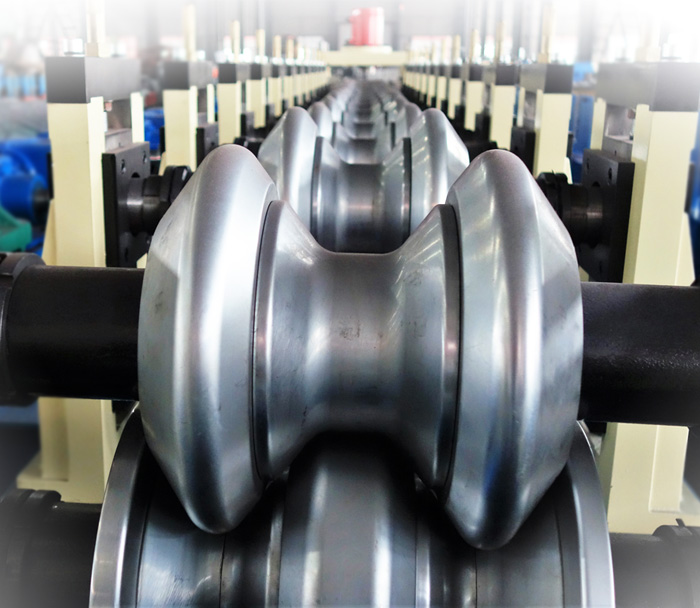

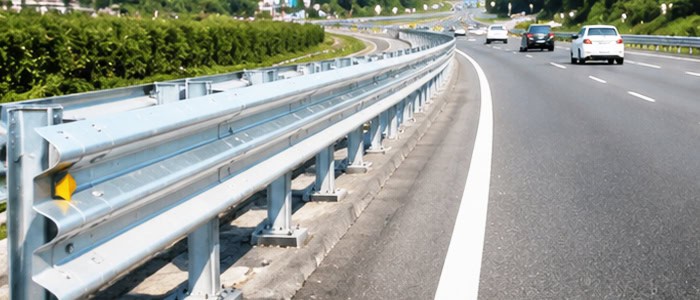
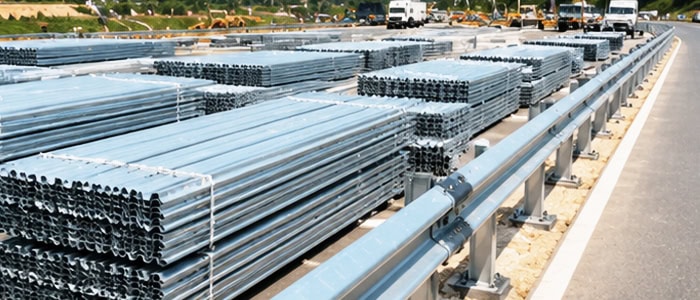
Application: W Beam Guardail, 2-Wave Highway Guardrail
Guardrail and barrier roll forming machines are widely used for manufacturing highway safety barriers, crash protection systems, and traffic infrastructure components that improve road safety and vehicle containment.


Explore the common questions and answers about Guardrail & Barrier Machines
A: The crash barrier roll former can produce common 2-wave (W-Beam) guardrails, 3-wave (Thrie-Beam) guardrails, and M-shaped guardrails. Some models support interchangeable production of 2-wave and 3-wave profiles.
A: It is suitable for galvanized steel, cold-rolled steel, hot-rolled steel, and anti-skid steel sheets. The typical thickness range for an expressway guardrail roll forming machine range is 2.0 mm to 3.2 mm, with heavy-duty versions supporting thicker materials.
A: Production speed varies depending on the configuration and material thickness. Normally, it runs at 0–15 meters per minute. With a flying shear or hydraulic cutoff system, cutting can be done without stopping the line.
A: For machines designed for dual profiles, you only need to adjust or replace part of the roller set. It does not require replacing the entire line, and switching can usually be completed within minutes.
A: The system is equipped with a PLC and touch-screen interface, with encoder feedback for length measurement. It supports automatic feeding, length setting, and hydraulic cutting. Advanced options may include remote monitoring and fault diagnosis.
A: Yes, we provide global installation and commissioning. Our engineers can travel to your factory to set up the machine and train your operators. Remote guidance, video tutorials, and manuals are also available.
A: Normally, the machine comes with a 2-year warranty (subject to contract terms). During this period, faulty parts caused by non-human damage are repaired or replaced free of charge. Spare parts and technical support are available beyond the warranty period.
A: With a heavy-duty frame, precision-machined rollers, and gearbox transmission, the expected lifespan of the w beam highway guardrail roll forming machines and 3 wave highway guardrail roll forming machine is 15–20 years with proper maintenance, making them a reliable investment for long-term production.

That’s right! Don’t want to miss out new machines launched, local events, special offers? Sign up to our emails to be notified of the first update.
We will use the information you provide on this form to be in touch with you and to provide updates and marketing. Your privacy will be well protected!