
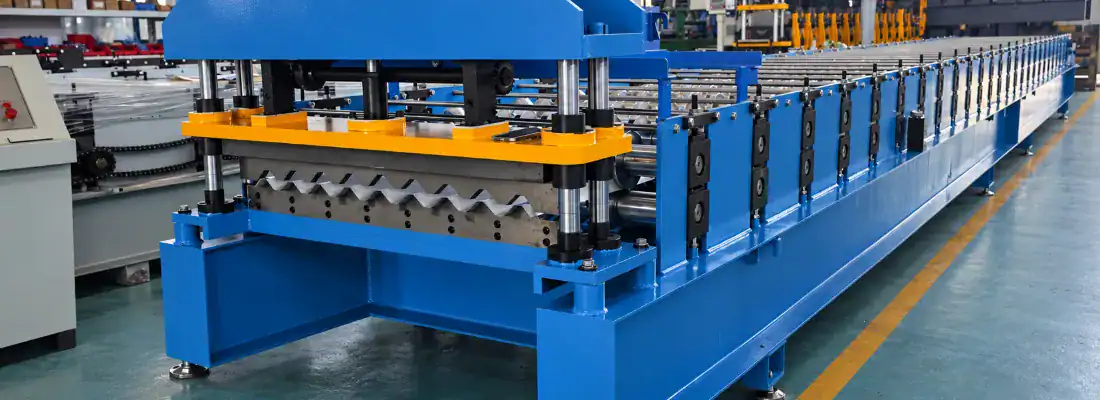
How to Prevent Galvalume Coating Cracking in Trapezoidal Roofing Profiles
How to Prevent Galvalume Coating Cracking During Trapezoidal Roofing Profile Roll Forming
Galvalume roofing profiles depend on a thin metallic coating for corrosion protection, and that coating is far less tolerant of bending strain than the steel beneath it. When manufacturers troubleshoot Galvalume roll forming cracking, the failure usually appears at the rib corners of trapezoidal profiles, not on the flat pans. This article explains where coating cracks originate, how Galvalume behaves differently from galvanized strip during bending, and which roll pass design and tooling decisions keep localized surface strain below the coating’s elongation limit.
Article Overview
Where Galvalume Cracking Appears in Trapezoidal Roofing Profiles
In a trapezoidal roof profile, coating damage rarely spreads across the whole sheet. It concentrates at predictable zones: the inner radius of each rib’s upper and lower bend, the transition between the web and the rib flank, sharp corner radii produced by aggressive early passes, and areas where the strip is stretched over a small roller radius under high pressure.
Visible failure typically appears as fine transverse lines, a crazed or milky surface, or micro-cracking that becomes a corrosion initiation site after installation. In many cases the steel substrate is still intact, so the defect passes a casual visual check on the line but fails later in service. This is why trapezoidal roof profile coating damage is often a pass-design problem rather than a material defect, and why it is usually detected first at rib corners rather than in the flat sections of the panel.
How Galvalume Coating Behaves Differently from Galvanized During Bending
Galvalume is an aluminum-zinc alloy coating, typically in the range of roughly 55% aluminum and 43.4% zinc with a small silicon addition. Compared with a conventional hot-dip galvanized coating, its microstructure is harder and less ductile. That difference matters during forming because the coating must stretch with the steel at the outer bend surface.
Galvanized coatings are relatively soft and can accommodate moderate bending strain by micro-cracking at grain boundaries without immediate visible failure. The alloy structure of a Galvalume coating has a lower effective Galvalume coating elongation limit under the same bend condition, so the coating can crack before the underlying steel reaches its own forming limit. Coating weight, substrate grade, and surface condition also shift that limit. A heavier coating, a higher-strength steel substrate, or a tighter bend radius all reduce the strain the coating can absorb before it fractures.
Why Rib Corners Concentrate Bending Strain

Rib corners are not just bends; they are bends with a defined inner radius that dictates how much the outer coating must stretch. For a given sheet thickness, a smaller inner bend radius produces higher surface strain at the outer fiber. Trapezoidal profiles are designed for stiffness, so designers tend to specify relatively tight radii at the rib corners, and that geometry works against coating integrity.
During Galvalume roof panel roll forming, the strain is not applied once. It accumulates progressively through the pass sequence as the strip moves from flat to final profile. If a single pass attempts to form too much of the corner angle, the outer coating experiences a sharp, localized strain peak. Reducing that peak depends on how the roll pass bend radius is distributed across the full forming sequence rather than on the final geometry alone.
Roll Pass Design Variables That Affect Coating Cracking
The forming sequence determines how much strain the coating sees at each station and how gradually that strain is introduced. The main variables are summarized below, and they should be treated as a coordinated system rather than independent settings.
| Pass Design Variable | Effect on Coating Strain | Practical Direction |
|---|---|---|
| Pass count and angle distribution | More passes with smaller angle increments reduce the strain peak at each rib corner; too few passes forces excessive bending in a single bite | Increase pass count so each station contributes a modest angle increment |
| Corner radius progression | Determines how gradually the inner radius closes across the sequence | Open the inner radius gradually rather than jumping to its final value in one or two stations |
| Overbend strategy | Overbend applied early increases outer-surface strain at the corner | Apply most springback compensation in the final forming stations |
| Material flow direction | Pinching the strip between rolls causes local thinning at the bend line | Allow the strip to flow longitudinally rather than pinching it |
| Pass sequencing of the ribs | Changes how strain redistributes along the sheet | Select the outer-first or inner-first sequence deliberately |
In practice, the goal is not to eliminate strain but to spread it across passes so that no single corner experiences a strain value above the coating’s effective elongation limit.
Tooling Clearance and Roller Surface Effects on Coating Damage
Tooling condition compounds the effect of pass design. When clearance between upper and lower rolls is too tight, the strip is squeezed rather than bent, and the coating is subjected to compressive plus tensile loading at the same surface point. When clearance is too loose, the strip can slip and form an irregular radius that concentrates strain.
Roller surface quality also matters on trapezoidal roof profile coating damage. A rough or worn roller surface drags across the coating on the outer bend surface and can initiate the micro-cracks that later propagate. Polished forming surfaces, adequate lubrication, and correct spring or pressure settings help keep the coating intact. Roll material selection and heat treatment affect how well the tooling holds that surface finish over long production runs, which is a practical consideration in any discussion of metal roofing components and forming practice.
Pass Design Rules for Stable Galvalume Roofing Production
For roofing roll forming tooling intended to run Galvalume strip, several pass-design principles tend to reduce cracking risk, even though exact values depend on substrate grade, coating weight, and profile geometry:
- Increase the number of forming passes so that each station contributes a modest angle increment at the rib corner.
- Keep the inner bend radius as generous as the profile permits, and taper it gradually across the pass sequence.
- Avoid aggressive overbend in early passes; apply most springback compensation in the final forming stations.
- Set roll clearance to allow bending rather than pinching, and verify it against actual strip thickness including coating.
- Maintain smooth, polished forming surfaces and consistent lubrication to reduce surface friction on the coating.
- Verify that the steel substrate and coating weight specified for the job are compatible with the intended minimum bend radius.
When a line already produces cracked rib corners, the practical starting point is to inspect the pass where the corner first reaches its final angle. In most cases the failure originates there rather than in the last station. Redistributing angle and radius across earlier and later passes, and re-checking tooling clearance and surface condition, resolves the majority of Galvalume roll forming cracking problems without changing the finished profile.
Galvalume roof panel roll forming at rib corners is fundamentally a strain-management problem. Galvalume’s thinner effective elongation compared with galvanized coatings means the roll pass sequence has less margin for error, so the forming line must introduce rib corner geometry gradually. Production engineers who treat pass count, bend radius progression, and tooling clearance as one coordinated system rather than independent variables will usually find that coating integrity holds at the rib corners without sacrificing profile accuracy.
Frequently Asked Questions
How many forming stations are needed for Galvalume profiles? ›
The required number of forming stations depends on profile geometry, substrate thickness and strength, coating weight, and the total deformation needed at each rib corner. More passes with smaller angle increments generally reduce localized strain peaks that cause coating cracks. As a practical guideline, buyers should provide the profile drawing, material grade, thickness range, and coating specification so the station count can be engineered around the coating’s elongation limit rather than chosen arbitrarily.
What roll clearance should be used for coated strip? ›
Roll clearance should allow the strip to bend rather than pinch it. It should be set against actual strip thickness, including the Galvalume coating, since ignoring coating thickness can effectively reduce clearance and squeeze the material. Clearance that is too tight adds compressive loading to the coating at the bend line, while excessive clearance allows slippage and irregular radius formation. The correct value depends on material thickness, substrate grade, and profile geometry, so it should be verified during commissioning trials.
Can a standard line run Galvalume without modification? ›
In many cases a standard trapezoidal roll forming line can run Galvalume, but the pass design and tooling must suit the coating’s lower effective elongation compared with galvanized strip. Key considerations include angle distribution across passes, inner radius progression, overbend placement, roll clearance, and roller surface finish. If the existing line was originally designed for galvanized or painted material with aggressive early bending, pass modifications or additional stations may be required to prevent rib corner cracking.
What information is needed to quote a Galvalume forming line? ›
Buyers should provide the profile drawing with rib dimensions and tolerances, material type including Galvalume coating weight, substrate grade, strip thickness range and coil width, required production speed, cutting method, punching or hole pattern requirements, electrical supply, and factory layout constraints. Changeover needs between profiles should also be stated. This information allows the supplier to engineer pass count, radius progression, tooling clearance, and drive configuration around the coating’s forming limits rather than quoting a generic line.
How can existing lines reduce rib corner coating cracks? ›
Start by identifying the pass where the rib corner first reaches its final angle, since most cracking originates there rather than in the last station. Then redistribute angle and radius across earlier and later passes, move aggressive overbend toward the final stations, and recheck roll clearance against actual strip thickness including coating. Inspecting roller surface finish and lubrication is also useful. Most Galvalume roll forming cracking problems are resolved by these pass and tooling adjustments without changing the finished profile geometry.
Does coating weight affect roll forming feasibility? ›
Yes. A heavier Galvalume coating reduces the strain the coating can absorb before it fractures, so a profile that forms acceptably with a lighter coating may crack with a heavier one. Substrate strength also matters, since higher-strength steel springs back more and may require different overbend compensation. Buyers should specify the exact coating weight and substrate grade early in the project so pass design and minimum bend radius can be evaluated against the actual material combination.
What roller surface finish is best for coated steel? ›
Smooth, polished forming surfaces generally reduce friction and dragging on the outer coating, which helps prevent the micro-cracks that later propagate. Rough or worn rollers can initiate surface damage even when pass design is correct. Roll material selection and heat treatment affect how well that finish holds over long production runs, and consistent lubrication supports the same goal. Buyers evaluating tooling should ask how forming surfaces are finished and maintained, not only how the rolls are dimensioned.
