

Solar Strut Channel Roll Forming Machines: A 41×21 & 41×41 Project Case
Chain vs. Gearbox Transmission: A Solar Strut Channel Roll Forming Machine Project for 41×21 and 41×41 Profiles
Two solar strut channel roll forming machines have completed machine trials and are ready for shipment. One line is configured for 41 × 21 mm strut channel profiles, the other for 41 × 41 mm profiles. Both machines use chain transmission, post-punching, and post-cutting with tracking punching and tracking cutoff. This solar strut channel roll forming machine project illustrates a practical engineering decision that buyers face early in line specification: whether to use chain transmission or gearbox transmission, and how that choice interacts with the rest of the line configuration.
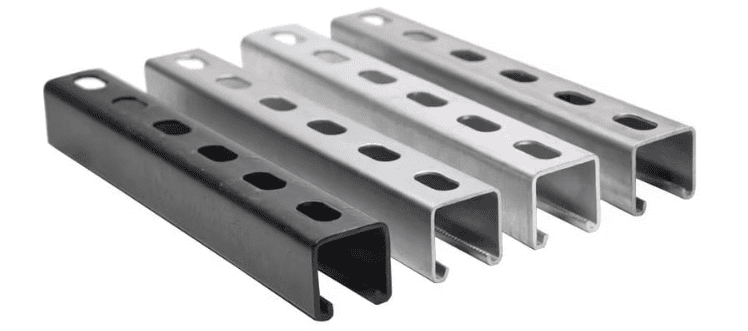
Table of Contents
Project Overview
The project covers two separate solar strut channel roll forming machines built for strut channel production. Both machines were specified with post-punching and post-cutting, which means the punching and cutting operations occur after the forming stages rather than in-line before forming. Both lines use tracking punching and tracking cutoff, so the punch and cut units move with the material during the operation instead of stopping the strip.
For this order, the customer selected chain transmission rather than gearbox transmission, based on cost considerations. Machine trials have been completed for both lines, and both machines are ready for shipment. For buyers researching a solar strut channel roll forming machine project, this case shows how transmission type is one of several configuration decisions that shape line cost and performance.
Machine and Application
The solar strut channel roll forming machines in this project produce solar strut channel, the slotted or plain channel sections widely used for mounting rails, brackets, and structural support in photovoltaic arrays. Strut channel geometry is defined by its width and height combination, and both profile sizes in this project are standard. Line speed was specified at 0–12 m/min, with forming performed on material ranging from 1.5 mm to 2.5 mm in thickness.
Because the two lines run different profile sizes, the number of forming stations, roll tooling dimensions, and punch and cut positions differ between them. What they share is the overall process sequence: coil feeding, roll forming, tracking punching, tracking cutoff, and run-out. This sequence supports continuous production, which is typical for strut channel used in solar mounting systems where long runs of consistent profile are required.
The key shared specifications and per-line configuration are summarized below.
| Parameter | Line 1: 41 × 21 mm | Line 2: 41 × 41 mm |
|---|---|---|
| Profile | 41 × 21 mm strut channel | 41 × 41 mm strut channel |
| Line speed | 0–12 m/min | 0–12 m/min |
| Material thickness | 1.5–2.5 mm | 1.5–2.5 mm |
| Transmission | Chain transmission | Chain transmission |
| Punching / cutting | Post-punching, post-cutting (tracking) | Post-punching, post-cutting (tracking) |
| Process sequence | Coil feeding → roll forming → tracking punching → tracking cutoff → run-out | Coil feeding → roll forming → tracking punching → tracking cutoff → run-out |
| Forming stations, roll tooling, punch/cut positions | Configured for 41 × 21 mm | Configured for 41 × 41 mm |
The differing profile sizes drive different forming stations, roll tooling dimensions, and punch and cut positions between the two lines, while the transmission type, control sequence, and process flow remain shared.
Technical Features and Project Requirements
The core technical choices in this solar strut channel roll forming machine project are the transmission type and the post-punching, post-cutting configuration. Chain transmission was selected here, but the comparison with gearbox transmission is worth understanding.
| Transmission type | Drive principle | Key characteristics | Notable trade-off |
|---|---|---|---|
| Chain transmission | Drives forming stations via chain and sprocket arrangement | Simpler layout; lower initial cost | Can accumulate some backlash over the full line length |
| Gearbox transmission | Distributes drive through gearboxes at each station | Generally better accuracy, higher speed, greater stability | Typically holds synchronization more tightly across stations |
The trade-off is practical rather than theoretical. A chain drive can experience some accumulation of backlash over the full line length, while a gearbox drive typically holds synchronization more tightly across stations. For strut channel, that difference can influence dimensional consistency at higher line speeds. Punching accuracy was specified at ±0.5 mm and cutting tolerance at ±1 mm for these machines, which the selected configuration was chosen to meet.
Project Progress and Results
Machine trials for both lines have been completed, and both machines are now ready for shipment. The trials covered the two profile sizes, 41 × 21 mm and 41 × 41 mm, and the post-punching and post-cutting sequence with tracking operations. Completing trials before shipment allows the forming, punching, and cutting functions to be verified together as a line rather than as separate units.
The project status is therefore straightforward: design and build are finished, trials are done, and the machines are prepared for dispatch. No further project milestones beyond shipment preparation have been confirmed for this case.
Engineering and Project Support
Choosing between chain and gearbox transmission is a normal part of specifying roll forming equipment. Buyers often weigh initial capital cost against accuracy, speed, and long-term stability, and the right answer depends on the profile, target output, and budget. Standards work related to steel forming and structural products, such as those published by ASTM International, provides useful background on material and product considerations, though machine configuration remains a project-specific decision.
For this solar strut channel roll forming machine project, the chain transmission choice kept the line aligned with the customer’s cost position while the tracking punching and tracking cutoff configuration addressed the need for continuous post-forming operations. Both machines have completed trials and are ready for shipment.
Frequently Asked Questions
When should I choose gearbox over chain transmission? ›
Choose gearbox transmission when dimensional accuracy, higher line speed, and long-term synchronization stability are priorities, since gearboxes typically hold timing more tightly across stations. Chain transmission suits buyers who prioritize lower initial cost and simpler layout, accepting that some backlash can accumulate over the full line length. The right decision depends on your profile tolerance, target output, and budget. Confirm your accuracy and speed requirements with the supplier before finalizing the configuration.
What does post-punching and post-cutting mean for my line? ›
Post-punching and post-cutting means the punch and cut operations happen after the forming stages, rather than before forming. Combined with tracking, the punch and cut units move with the strip during operation instead of stopping it, which supports continuous production. This arrangement often suits solar strut channel runs where consistent profile output matters. Buyers should confirm hole pattern, hole spacing, cut length, and tolerance requirements with the supplier, since these directly shape the punching and cutting configuration.
What information is needed to quote a strut channel line? ›
Provide the profile drawing with exact width and height, material type and thickness range, coil width, required line speed, hole pattern, and cut length. Also specify punching and cutting requirements, dimensional tolerances, electrical supply, and factory layout. If you plan to run more than one profile size, state that upfront, since forming stations, roll tooling, and punch and cut positions differ by profile. Complete input data allows the supplier to propose the correct transmission type and line configuration.
How is line speed determined for strut channel forming? ›
Line speed depends on profile geometry, material thickness, the number of forming stations, transmission type, and the required punching and cutting tolerances. Higher speeds usually demand tighter synchronization between stations, which can favor gearbox transmission. Buyers should treat line speed as a target to be validated against the whole process sequence, not a standalone figure. Confirm attainable speed with the supplier based on your specific profile, material, and accuracy requirements before approving specifications.
What determines the number of forming stations required? ›
Forming station count depends on profile geometry, material properties, material thickness, and the total deformation needed to reach the finished section. More complex or thicker profiles generally require more stations to avoid overworking the material. Two lines running different profile sizes, such as 41 × 21 mm and 41 × 41 mm, will normally need different station counts, roll tooling dimensions, and punch and cut positions. Confirm the station layout against your profile drawing before approving the design.
What should be verified before shipment of a roll forming line? ›
Machine trials should verify forming, punching, and cutting working together as a complete line, not as separate units. Buyers should confirm the profile dimensions, hole positions, cut length, and target tolerances against the agreed specification. It is also worth checking the tracking punch and cutoff response, line speed range, and control sequence. Confirm documentation, tooling lists, and any spare parts before dispatch. Completing these checks before shipment reduces commissioning time at your factory.
Can one strut channel machine run multiple profiles? ›
In principle, yes, but multi-profile capability depends on profile sizes and how much they differ. Each profile size typically requires its own roll tooling set, and the forming stations, punch positions, and cut positions may need adjustment or changeover. Running very different profiles on one line can increase changeover time and cost. If you plan to produce several strut channel sizes, state all profiles and expected changeover frequency during quotation so the line can be configured accordingly.
