
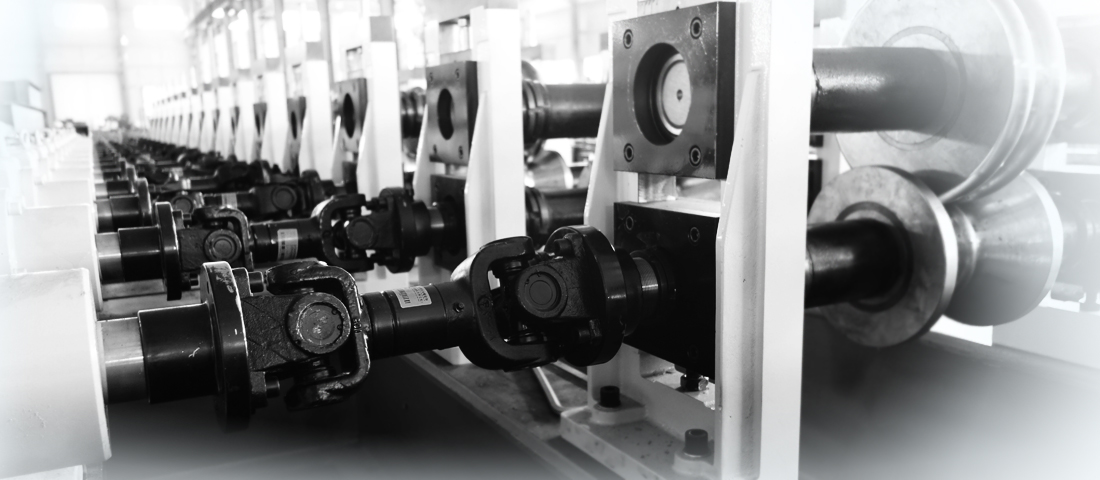
Transmission of Roll Forming Equipment: Which Type Does Your Machine Use?
Whenever an end user or a machine distributor plans to purchase a roll forming machine, they need to keep an eye on the transmission roll forming equipment.
A cold roll forming equipment usually consistis of decoiler, feeding unit, leveling unit, punching unit, roll forming uint, cutting unit, hydraulic unit, control unit and transmission unit.
The three commonest transmission of roll forming equipment are as following:
- Chain Sprokets
- Worm and Gear
- Coupling Gearbox and Universal Joint-shafts
Different manufacturers will use transmission methods for the roll forming euipment according to techcnical needs or clients’ requests.
We can find chain sprokets transmission anyway in our daily life, like bicycles, and in industrial occassions, like roll formers. However, we can find Worm and gear and Coupling Gearbox and universal joint shafts transmissions mostly applied for industrial usage.
COLD ROLL FORMING MACHINE WITH CHAIN-SPROCKETS TRANSMISSION.

In a cold roll forming equipment, suppliers tend to apply chain-sproket tranmission for producing thin metal sheets (less than 3mm). Usually we can find chain-sprockets transmission on corrugated sheet roll forming machine, C/Z purin roll forming machine and stud and track roll forming machine etc.
Chain-sprokets transmission is a cost effective transmission method! It does not require clean working environment, even dust won’t stop its working! The weak point is that long-time running will cause wear and tear. Besides, chain-sprockets transmission method is not suitable for high-precision or accuracy application because it doesn’t play well on controlling the tolerance of cutting length.
COLD ROLL FORMING MACHINE WITH GEARBOX TRANSMISSION.

In most of roll forming equipment handling materials over 3mm thickness or working at a speed over 20m/min (appro. 80ft/min), gear boxes and universal joint shafts will be mounted, like a highway guardrail roll forming machine; in high precision or accuracy roll formers, like some stud and track roll forming machines, manufacturers also apply apply gearbox and universal joint shaft to drive the machine.
Gearbox and universal joint shafts are strong and heavy! This type of transmission can provide big power to roll formers so that the roll formers could work stable and ensure the precision or accuracy of the final roll formed products. On the other hand, we cannot deny the truth that this transmission method costs much more than the other two. Fruthermore, clients have to place the roll forming machine with such tranmssion method in clean workshop with no dust. Another black side is gear-box transmission roll former will require more working area than the equipment with other transmission method.
COLD ROLL FORMING MACHINE WITH WORM-GEAR TRANSMISSION.

Worm-gear transmission is suitable for roll forming light, thin and small products at a normal speed (less than 15m/min, appro. 50ft/min). However sometimes can also be applied on a roof panel roll forming machine as per clients’ requirements.
Worm and gear transmission method is applied not too often! However, still there are fans of such transmission because it’s lighter than gear-box transmission and ensures stable working of the cold roll forming equipment.
Worm-gear roll forming machine transmission costs much more than chain-sprockets roll forming machine transmission but costs less than a gear-box roll forming machine transmission. In some occassions, especially for light weight steel roll forming machines, it can replace gear-box. On one hand it can ensure the precision or accuracy of the final products, and stable running of equipment, and on the other hand it costs less and requires smaller working areas.
MAXON® can design and build roll formers with each of the above mentioned transmission method. You may just advise your preference and we will make proper offe as per your requests. You can visit our Youtube Channel to see the trial running of our machines.
Frequently Asked Questions
How do I know which transmission type is right for my material thickness? ›
The page indicates that chain-sprocket transmission is commonly used for forming thin metal sheets, typically under 3mm. Gearbox and universal joint shaft transmission is the choice for materials over 3mm thickness or when higher running speeds are needed. Worm-gear transmission is suitable for lighter, thinner, and smaller products at normal speeds. Your material thickness is the primary factor; confirm the exact gauge with the manufacturer to ensure adequate torque.
Are there cutting-length tolerance differences between the transmission types? ›
Yes, the page states that chain-sprocket transmission has limitations in controlling the tolerance of cutting length and is not suitable for high-precision applications. Gearbox and universal joint shaft transmission are intended for high-precision or high-accuracy roll formers, ensuring more stable and precise final product dimensions. Other transmission options like worm-gear may also offer better precision than chain-sprocket, so state your required tolerance when requesting a quote.
Can I request a specific transmission type on my roll forming machine from MTC? ›
The page clearly states that different manufacturers choose transmission methods based on technical needs or client requests, and MAXON (MTC) can design and build roll formers with each of the three transmission methods discussed. When you are ready to order, advise the manufacturer of your preferred transmission type—chain sprocket, gearbox, or worm-gear—and they will make a proper offer according to your request.
What are the main trade-offs between cost and performance for each transmission type? ›
Chain-sprocket transmission is the most cost-effective but may require more maintenance due to wear and tear over time. Worm-gear transmission costs more than chain-sprocket but less than gearbox, offering a balance for lighter products. Gearbox and universal joint shafts are the strongest and most precise, but are the most expensive and require a clean, dust-free workshop with extra floor space. Your choice should balance required accuracy against your budget.
Are there any special installation or environmental requirements for these transmission types? ›
Yes, the working environment is a key consideration. Chain-sprocket transmission does not require a completely clean environment and can continue working even when dust is present. In contrast, the page emphasizes that gearbox and universal joint shaft transmission machines must be placed in a clean workshop with no dust, and they also require a larger working area compared to other transmission methods. Plan your facility accordingly.
Which transmission method is used for machines producing products like highway guardrails or roof panels? ›
For heavy-duty products like highway guardrails, which typically involve thicker material, gearbox and universal joint shaft transmission is used to provide large power and ensure stability. For roof panel roll forming machines, worm-gear transmission may be applied per client requirements, often when the product is light and thin, and the machine runs at normal speed. Always check the specific machine configuration for your material.

[…] Transmission of Equipment: There are three commonest transmission methods for roll forming equipment, i.e: Chain-Sprokets, Worm-Gear, and Coupling Gearbox and Universal Joint-shafts. Each transmission methods will have its own costs (See article WHAT TRANSMISSION IS APPLIED ON YOUR COLD ROLL FORMING EQUIPMENT?). […]
[…] There are three commonest transmission methods for roll forming equipment, i.e: Chain-Sprokets, Worm-Gear, and Coupling Gearbox and Universal Joint-shafts. Each transmission methods will have its own costs (See article WHAT TRANSMISSION IS APPLIED ON YOUR COLD ROLL FORMING EQUIPMENT?). […]
[…] Designing. The modern cold roll forming machines have various kinds of ID designing, from the transmission unit, to the roll forming stands designing. Also, cooling system and safety barriers have been necessary […]
[…] Designing. The modern cold roll forming machines have various kinds of ID designing, from the transmission unit, to the roll forming stands designing. Also, cooling system and safety barriers have been necessary […]
[…] A glazed tile roll forming machine typically produces metal roof tile with steps out of 0.3-0.6mm thick material. Usually a regular glazed roof tile roll forming machine has integrated forming stands and chain-sprockets transimission. […]