

Why Roll Forming Tooling Design Has a Greater Impact Than Many Manufacturers Expect
Roll Forming Tooling Design Is the Key for The Whole Machine Fabrication
When discussing production equipment, conversations often focus on line speed, automation level, or machine configuration. While these factors are important, experienced manufacturers know that the forming rollers themselves largely determine whether a production line can consistently deliver accurate profiles over months or years of operation.
As customers demand tighter dimensional tolerances, more complex cross-sections, and higher-strength materials, roll tooling has become a strategic element of modern production planning rather than simply a consumable component.
For manufacturers engaged in metal profile production, properly engineered tooling contributes to consistent profile geometry, stable operation, and predictable maintenance schedules throughout the life of the production line.
Table of Contents
Profile Geometry Begins with the Tooling Layout
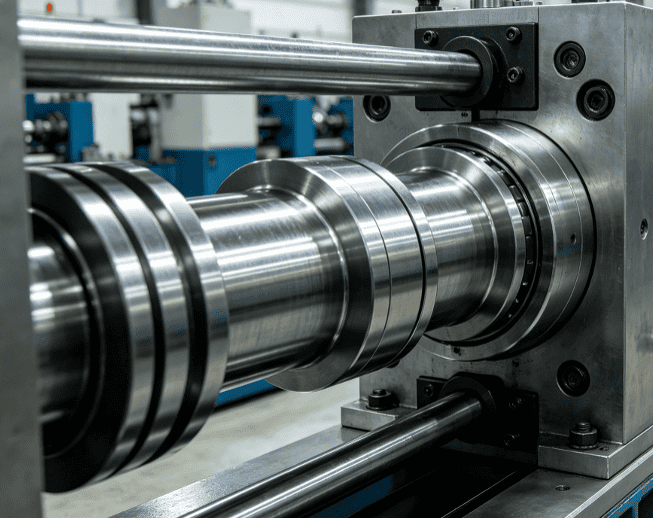
Successful roll tooling design is based on the gradual distribution of forming loads rather than forcing the material into its final shape within only a few stations.
Each forming pass should introduce controlled deformation while allowing the material to flow naturally into the next stage. If too much forming is concentrated in a limited number of stations, manufacturers may encounter twisting, edge waviness, flange distortion, or excessive springback.
This principle applies across many applications, including C and Z purlins, Sigma sections, cable trays, storage rack uprights, solar mounting rails, drainage profiles, and architectural cladding.
Although different products require different forming strategies, gradual deformation remains one of the fundamental principles of cold roll forming.
Material Characteristics Influence Tooling Decisions
Steel specifications continue to evolve.
Many production lines now process high-strength galvanized steel, stainless steel, aluminum, and coated materials on the same equipment. Each material responds differently during bending, requiring forming roller designed to accommodate varying yield strengths and springback behavior.
Higher-strength steels generally require greater attention to forming progression, while decorative coated materials demand smooth roller surfaces that minimize the risk of surface marking.
Manufacturers increasingly evaluate tooling together with material selection rather than treating these as separate engineering decisions. Stable production often depends on finding the correct balance between roller geometry, material properties, and forming sequence.
Surface Finish Matters Beyond Appearance
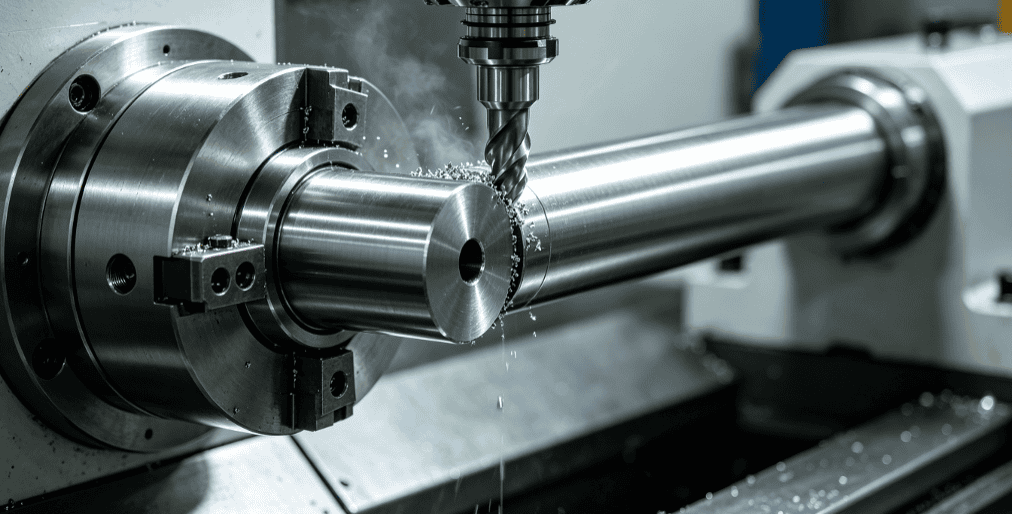
Roller surface quality affects more than visual appearance.
Poor surface condition may increase friction between the strip and the tooling, contributing to unstable material progression, localized wear, or inconsistent profile dimensions over extended production runs.
Precision-machined and properly heat-treated rollers help maintain repeatable forming performance while reducing unnecessary wear.
Routine inspection also remains important. Operators commonly monitor roller surfaces, shaft alignment, bearings, spacers, and fastening components as part of preventive maintenance programs designed to maintain long-run production stability.
Rather than waiting for Metal Profile Production Engineering quality to decline, many manufacturers schedule periodic tooling inspection based on production volume.
Roll Forming Tooling Design Should Match the Entire Production Line
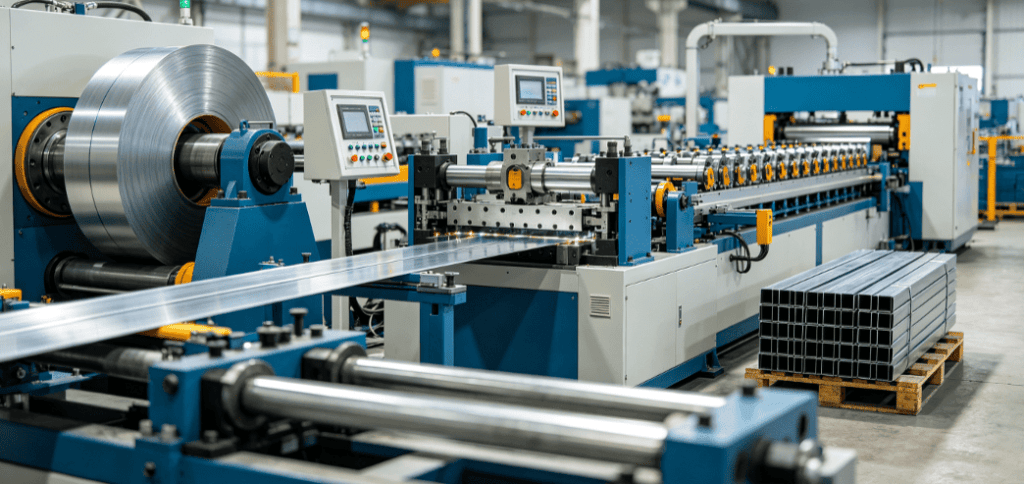
Cold Roll Forming Tooling cannot be evaluated independently from the rest of the equipment.
A well-designed tooling set performs best when combined with stable material preparation, accurate feeding, synchronized punching, and reliable cutting systems.
A typical production configuration may include:
- Hydraulic decoiler
- Precision leveling system
- Servo feeding equipment
- Hydraulic punching station where required
- Roll forming machine
- Flying or hydraulic cutting system
- Automatic stacking equipment
Each section contributes to maintaining profile alignment and dimensional consistency throughout continuous production.
For long-length standing seam roofing panels produced on trailer-mounted or containerized systems, tooling design also considers portability and continuous on-site manufacturing. These mobile production systems allow customers and contractors to manufacture virtually unlimited panel lengths directly at construction sites while maintaining consistent profile quality.
For manufacturers planning sustained production of specialized profiles, equipment suppliers may occasionally participate in Precision Roll Tooling validation and trial production before commercial manufacturing begins. Such cooperation is generally appropriate for stable, long-term production programs rather than short manufacturing campaigns.
Technical publications from the European Committee for Standardization (CEN) and the European Steel Association (EUROFER) provide useful references on steel products, manufacturing standards, and industrial practices relevant to profile production.
As profile designs continue becoming more sophisticated, tooling engineering remains one of the most important factors influencing reliable manufacturing performance.
Frequently Asked Questions
Roll tooling determines how the material is gradually formed, directly affecting profile accuracy, dimensional consistency, and long-term production stability.
Different materials exhibit different springback characteristics and forming behavior, requiring tooling designed for their mechanical properties.
Yes. Inadequate tooling design may lead to twisting, flange distortion, edge waviness, or inconsistent profile dimensions.
Inspection frequency depends on production volume, but regular checks of roller surfaces, bearings, shafts, and spacers help maintain stable operation.
Yes. Trailer-mounted and containerized systems often use tooling optimized for continuous production of long roofing panels while maintaining equipment mobility.
In most cases, each profile requires its own dedicated tooling design, although modular production concepts may share parts of the production platform.
