


In-House Design & Manufacturing
All our machines are designed, manufactured, and assembled in-house, ensuring full control over quality and delivery.
In-house design and manufacturing of custom roll forming machines for high efficiency, precision and flexible production.
Explore our most popular roll forming machine solutions for roofing, structural, and industrial applications.
All our machines are designed, manufactured, and assembled in-house, ensuring full control over quality and delivery.
We provide fully customized roll forming solutions based on your drawings, production requirements, and technical specifications.
We handle not only standard profiles, but also complex and customized designs with multiple punching and roll forming requirements.
Punching, cutting, roll forming and automation can be configured based on your production needs.
All machines are covered by a 24-month warranty, ensuring reliable operation and long-term production support.
Machines have been delivered to 50+ countries, adapted to different standards and working conditions.
Roll forming lines are widely used across multiple industries requiring efficient, high-precision metal profile production.

Steel framing, roofing systems, purlins, wall panels, and structural components.
Storage racks, shelving systems, and structural frames.
Mounting structures, support rails, and drainage channels for photovoltaic installations.
Highway guardrails, Reinforcement profiles, lightweight structural parts, and metal components.
Cable trays, cable ladders, windows and door frames, and equipment support systems.
Greenhouse framing systems, support structures, and ventilation profiles.



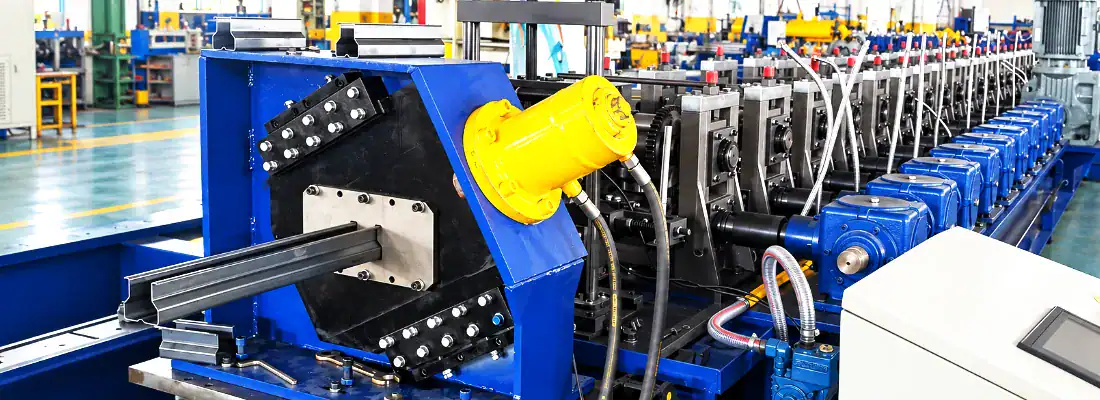
How Side Roll Pass Design Controls Flange Angle and Width Tolerance in Rack Upright Roll Forming Rack uprights are the load-bearing columns of a storage rack system, and…
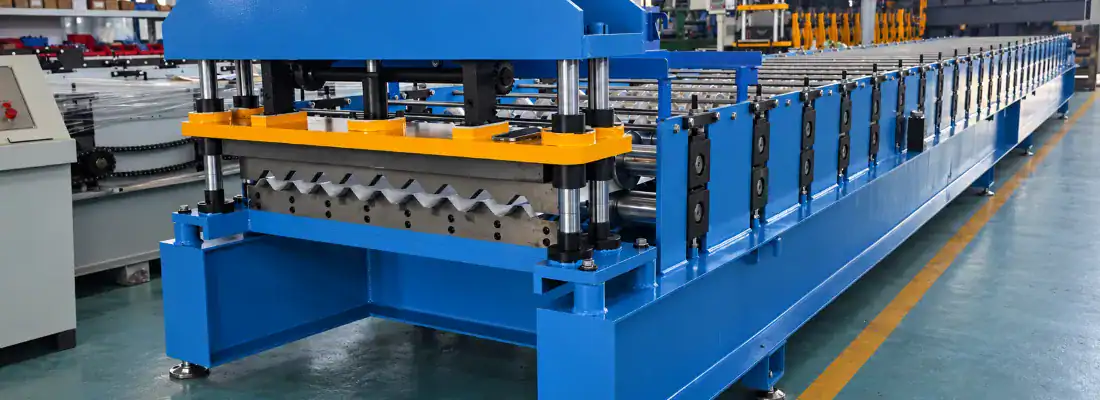
How to Prevent Galvalume Coating Cracking During Trapezoidal Roofing Profile Roll Forming Galvalume roofing profiles depend on a thin metallic coating for corrosion protection, and that coating is…

Chain vs. Gearbox Transmission: A Solar Strut Channel Roll Forming Machine Project for 41×21 and 41×41 Profiles Two solar strut channel roll forming machines have…

Shaft Deflection in Wide Floor Deck Roll Forming: How Bearing Spacing Controls Profile Consistency Wide floor deck profiles are among the most demanding products to hold to a…
to continuously shape sheet metal into specific profiles by passing it through a series of precisely aligned rollers.
The process starts when flat metal coils are loaded into the uncoiler and fed into the machine. As the sheet passes through multiple roll stations, each set of rollers incrementally bends the material until the desired cross-sectional shape is achieved.
This cold forming technique maintains the metal’s thickness while improving its strength and dimensional accuracy. Roll forming is widely used in the production of purlins, metal roofing panels, sandwich panels, garage door panels, and more.
Compared to press brakes or stamping, roll forming offers higher production speed, consistent quality, and cost efficiency for medium to large-scale manufacturing.
More details at our post Unravelling the marvels of Roll Forming Machines.
C and Z purlins are structural steel members used to support roofing and wall cladding in metal building construction. The main difference lies in their shape and application. C purlins have a consistent C-shaped cross-section and are typically used as roof purlins, wall girts, and structural frames where one orientation suffices. Z purlins have a Z-shaped cross-section with an overlapping design that allows them to interlock and be lapped for continuous runs, providing greater structural efficiency over longer spans. Z purlins are commonly chosen when the design requires overlapping sections or when optimizing material for large projects. Our C/Z purlin roll forming machines can produce both profiles with high precision.
More details at our post 7 Key Facts You Must Know about difference between C & Z purlins
Our roll forming machines are designed to process a wide range of materials, depending on your application and product requirements. Common materials include galvanized steel (GI), galvalume steel (GL), cold-rolled steel (CR), hot-dip aluminum-zinc coated steel, pre-painted color-coated steel, stainless steel, and sometimes aluminum sheets.
The machines are capable of handling thicknesses typically ranging from 0.3 mm to 6.0 mm, depending on the profile and material strength. We can also customize the machine design to suit specific materials or surface finishes, ensuring optimal forming performance and minimal surface scratches or deformation.
A PU sandwich panel is a building material consisting of two metal sheets bonded to a rigid polyurethane (PU) foam core.
PU sandwich panels are known for their superior thermal insulation, fire resistance, and long-term durability compared to expanded polystyrene (EPS) panels. PU foam has a much lower thermal conductivity, which means better energy efficiency in buildings.
Additionally, PU panels offer higher compressive strength, better dimensional stability, and reduced water absorption. While EPS panels are cheaper, PU panels provide a more premium solution for cold storage, clean rooms, and energy-efficient buildings.
Our PU sandwich panel production lines deliver high-quality panels with consistent foam density and excellent adhesion.
Selecting the right roll forming machine depends on several factors. Start by identifying the profile shape and dimensions you need, as this determines the roller design and machine configuration.
Next, consider the material type and thickness, which affect the machine’s forming force and power requirements. Production capacity is another key factor—high-speed lines are recommended for large-scale operations, while simpler manual machines can suffice for smaller jobs.
Also, evaluate the level of automation and budget you prefer. Our engineering team is ready to help you analyze your requirements and recommend the most suitable machine solution to ensure optimal performance and return on investment.
Yes, MTC is specialized in manufacturing fully customized roll forming machines, like floor decking roll forming machine, solar channel roll forming machine, based on your profile drawings and technical specifications. Whether you have standard or non-standard profiles, our engineers will design the roller layout, machine frame, and punching systems to accurately produce your desired shape. We can also integrate additional features such as automatic cutting, punching, embossing, and stacking according to your production needs. Before manufacturing, we’ll provide detailed CAD designs and discuss every detail with you to ensure the final machine meets your expectations.

That’s right! Don’t want to miss out new machines launched, local events, special offers? Sign up to our emails to be notified of the first update.
We will use the information you provide on this form to be in touch with you and to provide updates and marketing. Your privacy will be well protected!