
6 Ways a Steel Door Frame Roll Forming Machine Improves Daily Life
A steel door frame roll forming machine plays a crucial role in improving our lives in various ways. By automating the process of manufacturing steel door frames, these machines offer numerous benefits that enhance efficiency, quality, and overall convenience.
Table of Contents
How a steel door frame roll forming machine improves our lives:
- Enhanced Efficiency: Steel door frame roll forming machines streamline the production process by automating the bending, cutting, and shaping of steel sheets into door frames. This automation significantly reduces labor-intensive manual work and increases the speed of production. As a result, manufacturers can produce door frames at a much faster rate, leading to increased productivity and shorter lead times.
- Consistent Quality: These machines are designed to produce door frames with precise dimensions and uniform quality. The automated process ensures that each piece is formed accurately and consistently, eliminating variations that may occur with manual fabrication. Consistent quality is crucial for door frames, as it ensures proper installation, durability, and long-term performance. By maintaining high standards of quality, steel door frame roll forming machines contribute to safer and more reliable buildings.
- Customization and Flexibility: Steel door frame roll forming machines are highly versatile and can be easily adjusted to produce door frames of different sizes, profiles, and designs. This flexibility allows manufacturers to cater to a wide range of customer requirements and adapt to changing market demands. Whether it’s residential, commercial, or industrial applications, these machines enable the production of customized door frames, offering greater design options and fulfilling diverse needs.
- Cost Savings: Automating the production process through a steel door frame roll forming machine helps reduce labor costs and material waste. The precise shaping and cutting capabilities of the machine minimize material losses, optimizing material usage and minimizing scrap. Additionally, the increased production speed and efficiency lead to higher output, enabling manufacturers to meet demand effectively. These cost savings can be passed on to customers, making steel door frames more affordable and accessible.
- Improved Durability and Safety: Steel door frames produced by roll forming machines are known for their strength, durability, and resistance to various environmental factors. The precise forming process ensures that the frames have the necessary structural integrity to withstand heavy use, impacts, and other external forces. The increased durability contributes to safer buildings, providing enhanced protection against break-ins, fires, and natural disasters.
- Sustainability: Steel door frame roll forming machines promote sustainable manufacturing practices. They help minimize material waste by optimizing material usage and reducing scrap generation. Additionally, the energy efficiency of these machines, coupled with their high production output, results in a reduced carbon footprint. By adopting roll forming technology, manufacturers can contribute to environmental conservation and meet the growing demand for sustainable construction solutions.
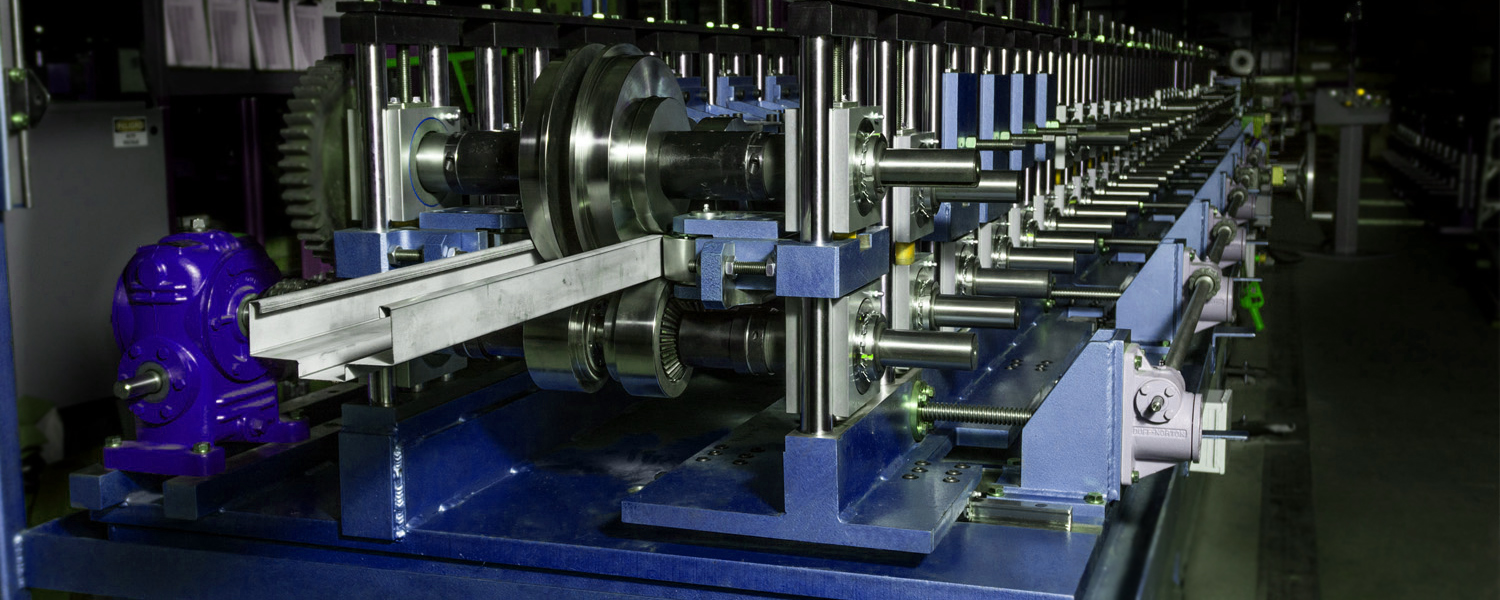
Steel Door Frame Roll Forming Machine
In summary, a steel door frame roll forming machine brings significant improvements to our lives. It enhances production efficiency, ensures consistent quality, enables customization, reduces costs, improves durability and safety, and promotes sustainability. Related door components roll forming machines can be viewed. By revolutionizing the manufacturing process, these machines contribute to safer buildings, cost-effective solutions, and a more sustainable construction industry.
Frequently Asked Questions
What types of steel sheet materials can be processed with a steel door frame roll forming machine? ›
The page states that steel sheets are processed, but does not specify particular grades or coatings. In practice, machines are commonly used with galvanized steel, cold-rolled steel, or stainless steel depending on the required corrosion resistance and strength of the finished frame. The specific material grade and coating (e.g., zinc coating thickness) influence the machine’s roll tooling wear and forming behavior, so consulting the manufacturer with your material specification is recommended before selecting a machine.
What are suitable material thickness and width ranges for a steel door frame roll former? ›
The page emphasizes that the machine bends, cuts, and shapes steel sheets into door frames but does not list specific thickness or width parameters. These ranges depend on the door frame profile design and the machine’s roller tooling. Standard residential door frames are typically produced from steel sheets in a range roughly between 0.5 mm and 2.0 mm thick, but custom applications may vary. For an accurate range, contact MTC Industrial with your intended material and profile drawing.
Can a steel door frame roll forming machine produce frames with different profiles and cut lengths without changing the machine? ›
Yes, as noted in the page, the machines are highly versatile and adjustable for different sizes, profiles, and designs. However, changing the profile typically requires replacing or adjusting the roll tooling stations, which takes time and may require additional tooling sets. Cut lengths can usually be adjusted using the machine’s programmable controller, allowing production of frames for different door heights or widths within the same profile family. Confirm the level of automation and tooling change time with the manufacturer for your specific production needs.
What punching or cutting options are available on a steel door frame roll forming line? ›
The page indicates the machine automatically cuts steel sheets into lengths but does not detail punching or notching capabilities. For door frames, common pre-punching tasks include holes for hinges, strike plates, and mounting screws, as well as notching for corners. These tasks can be performed in-line with hydraulic punching units placed before or after the forming stations. Because the page does not specify which options are standard, discuss your precise punching layout and tolerances with MTC to ensure the line meets your requirements.
What is the typical production speed of a steel door frame roll forming machine, and how many frames per day can it produce? ›
Production speed is not stated on this page. It depends on several factors including the length of the frame, material thickness and type, complexity of the profile, the number of punching or cutting operations performed in-line, and the operator’s experience. Generally, roll forming is a continuous process, so speeds are measured in meters per minute, and final daily output also depends on how frames are stacked and packaged. For a reliable estimate, supply MTC with your frame dimensions and material details, and they can calculate a throughput projection.
What are the electrical requirements for installing a steel door frame roll forming machine at our facility? ›
Electrical requirements are not covered in the existing page content. They vary among machine models, as total power consumption depends on the number and rating of the forming stations, servo motors, cutting system, hydraulic power units (if applicable), and control system. You will need to request the specific machine’s technical datasheet from MTC, which typically lists the required voltage (e.g., 380 V/50 Hz or 480 V/60 Hz) and total connected load (kW). Have your facility’s available power supply details ready to verify compatibility.
How should I request a quotation for a steel door frame roll forming machine? What information does MTC require? ›
To obtain an accurate quotation, you should provide MTC with your desired finished door frame drawings (dimensions and cross-section profile), the steel coil specifications (material grade, thickness, width), required production output per day, and any specific punching or cutting features needed. If you do not have a final profile, share your application requirements (residential, commercial, industrial) so their engineers can propose a suitable design. The more details you supply, the more tailored the machine configuration and pricing will be.
