

Clients from Span visited for the order of Cassette type roll forming machines
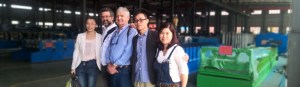
MTC had clients visited from Span this morning to discuss about the order of roll forming machine that could produce steel C, U and L section profiles on one machine and as both agreed that only a cassette type roll forming machine would be possible to do the job.
The section profiles are mainly applied in solar projects, and therefore only tiny tolerance for the dimensions and lengths of the final products can be acceptable. The raw material will be 4mm carbon steel or galvanized steel and the weight of the biggest coil would be approximately 10 metric tons. During the meeting, concluded is made after careful discussion that a roll forming machine with 4 cassettes is necessary, and gearboxes and universal joint shafts are used as the transmission tools. Non-stop tracking cutter also is required to reach high production speed.
It is easy to produce different c shaped steel purlin with one cassette, but when it comes to too many profiles, the sizes and thickness range will have to be considered. Like a c purlin roll forming machine could handle with thickness from 1.6-3.2mm or 2.5-4mm (1.5mm would be the max difference); and also a c purlin machine can make profile 80-300 or 40-80 (it’s not possible to produce any profles between 40-300) because there is min.thickness requirement for rollers and min. distance between spacers.
There is punching option required before roll forming, and a high speed pressing machine, as mutually agreed, would be placed between decoiler and roll former, so the whole layout is gonna be decoiler, levelor, servo feeder, punching machine, feeding guide, roll forming, Turkey straightening machine, fly-saw cutter and pneumatic staker. The whole line is controled by Siemens PLC computer control box for the controlling of material feeding, plain sheet punching, roll forming and fly-saw cutting etc.
The meeting went well and there is a better understanding mutually between MTC and clients. According to clients, everything is clear, and they were quite satisfid with the machines designed by MTC. It could be seen and as we wish that the forthcoming event will be a great success for both our sides.
Frequently Asked Questions
What types of profiles can a cassette type roll forming machine produce? ›
Based on this project, a cassette type machine was selected specifically to produce C, U, and L section profiles on a single unit. This is achieved by changing cassettes for different profile shapes. The specific profiles and their dimensions depend on your project requirements. It is important to discuss all the profiles you need to produce with the machine manufacturer to ensure the correct number of cassettes and roller sets are configured.
What raw materials can this type of machine process? ›
For the application mentioned on this page, the raw material is carbon steel or galvanized steel. The example order specifies a material thickness of 4mm. The width of the material will depend on the final profile dimensions you need. Always verify with the manufacturer that the machine’s forming stations and cutting system are rated for the specific material grade, thickness, and width you plan to use.
How is a cassette type machine different from a standard roll forming machine? ›
A standard C purlin machine is typically limited to a specific size range (e.g., 80-300mm) and thickness range (e.g., 1.6-3.2mm or 2.5-4mm). A cassette type machine uses interchangeable cassette sets, allowing the same base machine to handle a wider variety of profiles and sizes. Each cassette contains the rollers for a particular profile shape, which makes production more flexible without needing separate machines for each profile.
What factors determine the number of cassettes needed for my project? ›
The number of cassettes is determined by the variety of profiles you need to produce and the difference in their dimensions. As shown in this case, producing C, U, and L sections required a 4-cassette configuration. If your profiles have very different dimensions or thicknesses, you may need more cassettes. The manufacturer will recommend the required number after reviewing your complete profile list and material specifications.
What is the typical production line layout for this kind of machine? ›
Based on this project, the complete line includes: a decoiler to hold the coil, a leveler to flatten the material, a servo feeder for precise feeding, a punching machine for holes or notches, a feeding guide, the roll forming machine itself, a straightening machine (Turkey type here), a fly-saw cutter for length cutting, and a pneumatic stacker for collecting finished products. This full line allows for continuous, automated processing from coil to stacked profile.
Can punching and cutting be integrated into the roll forming process? ›
Yes, integration is possible and often required. In this order, a high-speed pressing machine is placed between the decoiler and roll former for punching operations before forming. Also, a non-stop tracking fly-saw cutter was selected to cut profiles to length without stopping the line, which helps achieve high production speed. The entire process is coordinated by a PLC control system (like Siemens) that manages feeding, punching, forming, and cutting.
How is the accuracy of the final length maintained for solar project profiles? ›
Accuracy is critical, especially when profiles are used in solar projects where tolerances are tight. This system uses a PLC-controlled fly-saw cutter that tracks the moving profile to cut it to a precise length while the line is still running. The ‘non-stop tracking’ feature allows for consistent control of length, and the straightening process after roll forming helps ensure the profile straightness, contributing to the overall dimensional quality.
