For a regular roll forming machines buyer, Chinese equipments always come to mind considering China’s ‘reputation’ as world factory, and the lower price as well, but it really takes time and energy to find a reliable chinese roll forming machine supplier.
Table of Contents
A simple and regular case
There are unnumbered metal roll forming equipment suppliers (manufacturers and traders) in China, and a client can always get a reply if a inquiry has been sent to around 10 Chinese email address. Not everyone quotes on the basis of same technical specifications, and the quoted prices are also different, so it’s a real headache question how to choose a reliable supplier who can supply good quality machines as well as good quality service.
What to know before making a decision?
In order to choose a reliable and most subitable supplier for roll forming machine equipment, you have to be clear about the below 3 first of all:
FUNCTION or the PURPOSE: Why, where and when are you going to need that roll former? Is it for one-time project, or for long-run operation?
WORKING AREAS: If you have limited factory spaces, some roll formers have to be designed and built with different rollforming techniques.
FINANCIAL BUDGETS: Whatever prices you are looking at on the quotation sheets are subject to the technical specifications of the roll formers quoted. It’s like you have 300$ budget and you cannot expect an iphone 7. It’s understandable that you have 1000$ budget and are afraid of getting an uphone 7, and we will list some factors that decides the prices of rollforming equipment.
When you have free working areas and obvious purpose to purchase a roll former, the conclusive point for you to press that purchase button for roll former is your budget or your expected price and quality of the machine. The price always stands on one side of the Balance and quality as well as service stands the other.
What a reliable Chinese roll forming machine supplier will offer?
We’d like to list some technical specifications that could affect the prices of the roll forming machine you are going to buy as below:
Decoilers: A manual decoiler costs 300-500$, while a semi-auto decoiler or an auto decoiler may cost dozens of times. A manual decoiler is welded with steel and two bearings; a semi-auto decoiler requires a motor with reducer, and an auto decoiler has motor, hydraulic system, frequency inver, and control unit.Therefore the basic decoiler for a roll former is usually a manual decoiler, and if clients need different, there will be extra charges;
Shafts: Some suppliers may quote a roll former at an incredibly-low price (If you have offers at around 15000$ from three suppliers and one offer 5000$), it’s possible they will give you hollow shafts which shall not exists for any roll formers. And also the difference of shafts’ DIAMETER also indicats different roll former’s prices. FOr example, some factories in northern China (mostly Hebei province) may use shafts of 50/60mm diameter, and someone may use hollow shafts as well for a regular roofing and wall roll forming machine, while in Shanghai, Wuxi, and Hangzhou, roll forming machine manufacturers apply the shafts with standard diameter 70mm.
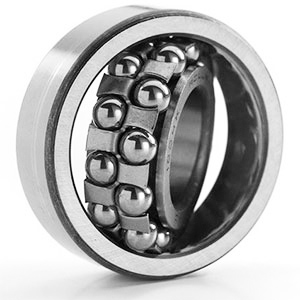
Bearings: There are incalculable bearing brands in China, and many of them are small workshops which makes low-quality bearings of short service life, but those bearings are really cheap, so if you got an offer for an unbelievably-cheap machine, you need to watch carefully because they might use the bearings made by some small obscure mills. While a good-quality Chinese equipment are usually driven by NSK bearings (Japanese bran), or HRB bearings (Top 1 Chinese brand).
Numbers of Stands: Different suppliers may quote machines with different roll forming stations or stands which are the core components of a roll former. Some cheap machines may have less forming stands than that required.
Structure of Stands: There are different forming stands structures: Integral Stands and Individual Stands. The integral stands are made of steel plates (thickness varies among 16mm to 20mm) and between two conjoint steel plates, the rolling tools are mounted; while individual stands are made of cast iron steel and the rolling tools are mounted inside. The individual stands are produced by the planer type milling-boring machine and some of them are also coated with decorative chrome. Different stands’ structures cost different.
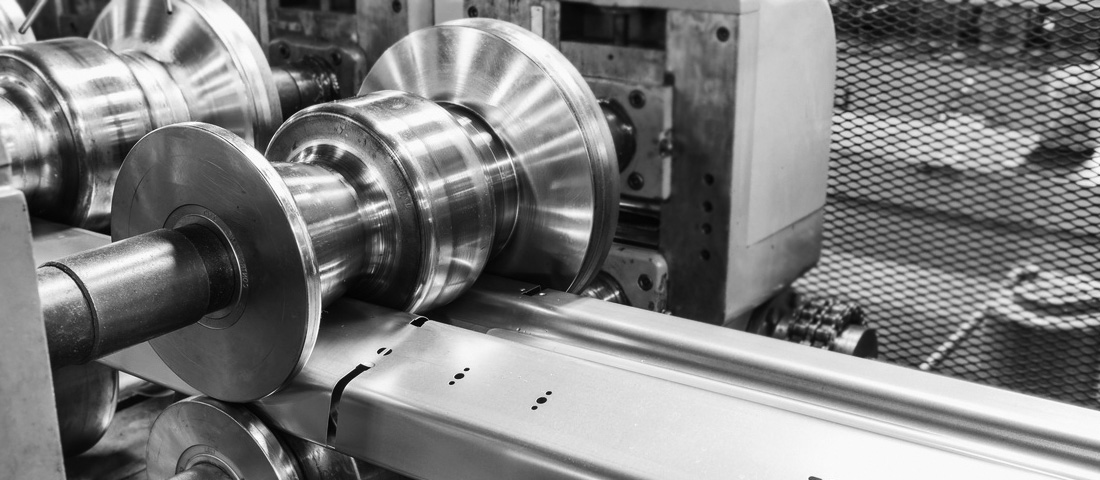
Material of Rolling Tools: There are different steel that can be applied as the raw maerial of rolling tools. When you receive Chinese quotation sheets, you probably noticed the material of rollers are usually 45# steel, Gcr15 bearing steel or 40Cr steel. 45# steel are suitable for roll forming materials less than 1.5mm thickness, and if you need to roll more than 2mm thickness products, GCR15 bearing steel are necessary to ensure longer life circle.
Machining Accuracy: If the raw material of a rollforming equipment plays 50% of the cost, the details and machining of a roll forming machine can decide 30% of the machine costs (See article HOW DOES MACHINING OPERATION MATTER TO ROLLFORMING SOLUTIONS?).
Transmission of Equipment: There are three commonest transmission methods for roll forming equipment, i.e: Chain-Sprokets, Worm-Gear, and Coupling Gearbox and Universal Joint-shafts. Each transmission methods will have its own costs (See article WHAT TRANSMISSION IS APPLIED ON YOUR COLD ROLL FORMING EQUIPMENT?).
Motor: Different suppliers may apply different motor power on their designed equipment based on their experience and costs saving, so motor power and brands shall be compared when reading different quotation sheets.
There are some other parts that may contribute to different quoted prices, like service, installation, and warranty etc. A client needs to compare the technical parameters from different quotation sheets and needs more talk with suppliers regarding their service as well.
Frequently Asked Questions
+What material thicknesses can a typical Chinese roll forming machine handle, and how does this affect supplier selection?›
The suitable material thickness depends on the machine’s design, particularly its rolling tool material and motor power. As explained on this page, 45# steel rollers are generally suitable for forming materials under 1.5mm thick, while GCR15 bearing steel is recommended for forming products over 2mm thick. When comparing supplier quotes, confirm that the proposed roller material and motor specifications align with your intended material thickness, as this is a core factor behind price differences.
+How do I compare quotations from different Chinese suppliers when the prices vary significantly?›
Price differences usually reflect differences in technical specifications, not just supplier markup. The page identifies key variables to compare across quotes: decoiler type (manual vs. auto), shaft diameter and whether they are solid or hollow, bearing brand (e.g., NSK or HRB vs. obscure low-cost brands), number of forming stands, stand structure (integral steel plate vs. individual cast iron), rolling tool material, machining accuracy, and transmission method. A much lower quote may indicate compromises in these components, so evaluate them line-by-line before deciding.
+What is the difference between integral stands and individual stands on a roll forming machine?›
Integral stands are fabricated from steel plates (usually 16mm–20mm thick), with the rolling tools mounted between two conjoined plates. Individual stands are cast from iron and machined on a planer-type milling-boring machine, with rolling tools mounted inside; they may also have decorative chrome coating. Both structures are valid, but they have different production costs and stiffness characteristics. When a supplier quotes a low price, check which stand structure is included, as this is a major cost component highlighted on this page.
+Why do some Chinese roll forming machine quotes include hollow shafts at a much lower price?›
A reliable roll former always uses solid shafts; hollow shafts are considered structurally deficient for roll forming and should not be used. If you receive an exceptionally low quotation (e.g., $5000 versus several at $15000), a likely cause is that the machine is built with hollow shafts. Beyond that, shaft diameter also matters—some factories in northern China use 50mm or 60mm diameters, while manufacturers in Shanghai, Wuxi, and Hangzhou typically apply a standard 70mm diameter. Always specify solid shafts with an adequate diameter in your RFQ.
+What role do decoilers play in the cost of a complete roll forming line?›
The decoiler is a separate component whose type significantly affects total machine price. A basic manual decoiler, welded from steel with two bearings, may cost only $300–$500. A semi-automatic decoiler adds a motor and reducer, while a fully automatic decoiler includes a motor, hydraulic system, frequency inverter, and control unit—costing many times more. Decide what coil handling capacity and automation level you need for your production environment, and confirm the decoiler type included in each supplier’s quote before comparing prices.
+How can I tell whether a low-priced Chinese roll forming machine uses low-quality bearings?›
China has countless small bearing workshops producing very cheap, short-life bearings. If a machine price seems unbelievably low, or if the supplier does not name the bearing brand, it may be using such components. Reliable Chinese equipment typically uses NSK (Japanese) or HRB (top Chinese brand) bearings. During quotation comparison, ask the supplier to specify the exact bearing brand and model for the forming stations. This is a clear indicator of quality commitment and long-term reliability.
How to choose a reliable Chinese roll forming machine supplier? was last modified: September 5th, 2026 by MAXON®
That’s right! Don’t want to miss out new machines launched, local events, special offers? Sign up to our emails to be notified of the first update.
We will use the information you provide on this form to be in touch with you and to provide updates and marketing. Your privacy will be well protected!
Discover more from Roll Forming Machine Manufacturer in China
Subscribe now to keep reading and get access to the full archive.