

Why Profile Straightness in Roll Forming Matters
Profile Straightness in Roll Forming is one of the most important quality indicators for cold-formed steel products. While buyers often focus on profile dimensions, hole positions, or cutting accuracy, straightness directly affects installation efficiency, structural performance, and overall product quality.
Even if every dimension falls within specification, excessive bow, camber, or twist can make profiles difficult to assemble, increase installation time, and result in customer complaints. Understanding the factors that influence profile straightness allows manufacturers to improve production stability and reduce costly rework.

Table of Contents
What Is Profile Straightness in Roll Forming?
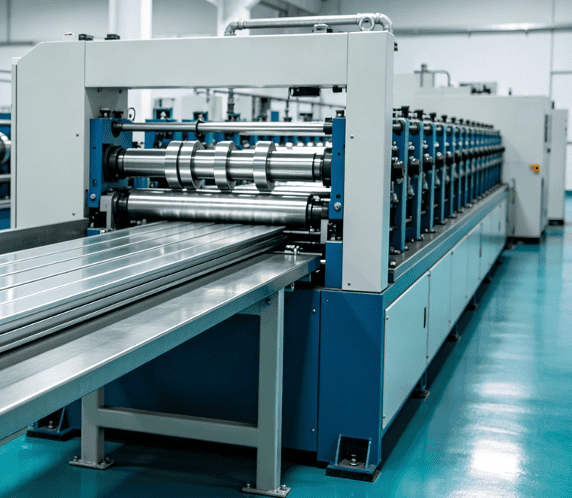
Profile straightness describes how accurately a finished profile maintains a straight longitudinal axis after forming and cutting.
Several types of straightness defects may occur during production:
- Longitudinal bow
- Side camber
- Profile twist
- Edge waviness
- Local distortion
Each defect has different causes and requires different corrective measures.
Manufacturers producing structural steel components generally specify strict straightness tolerances because these profiles must fit accurately during assembly.
Why Straightness Is Important
Poor straightness affects more than appearance.
Typical consequences include:
- Difficult installation
- Poor connection alignment
- Increased field adjustments
- Assembly gaps
- Reduced production efficiency
- Customer quality claims
For projects involving modular construction or automated assembly, profile straightness becomes even more critical.
Companies operating a Light Gauge Steel Framing Machine must maintain excellent straightness because framing components are assembled with precise dimensional tolerances on construction sites.
Common Causes of Profile Bow and Twist
Several production factors influence profile straightness.
Uneven Forming Forces
If roller pressure is not evenly distributed across the profile width, internal stresses become unbalanced.
This often results in:
- Side bow
- Twist
- Flange distortion
Proper roll tooling design helps distribute forming forces more uniformly.
Roller Misalignment
Misaligned rollers are among the most common causes of straightness problems.
Even small alignment errors can accumulate through multiple forming stations and affect the final profile.
Routine alignment verification is essential for maintaining production consistency.
Material Variation
Steel coils from different suppliers may exhibit variations in:
- Yield strength
- Thickness tolerance
- Residual stress
- Flatness
These differences influence how the material behaves during forming.
Manufacturers producing with a Steel Purlin Roll Forming Machine often verify incoming coil quality before production, particularly when processing high-strength galvanized steel.
Improper Forming Progression
Applying excessive deformation in early forming stations creates unnecessary internal stress.
A properly engineered forming sequence gradually shapes the material while maintaining balanced stress distribution throughout the profile.
How Manufacturers Improve Straightness
High-quality roll forming manufacturers combine several engineering practices to improve profile straightness.
Precision Roll Tooling
Well-designed tooling ensures:
- Balanced material flow
- Smooth deformation
- Stable forming progression
- Uniform roller contact
Accurate tooling significantly reduces the risk of bow and twist.
Machine Alignment
Regular inspection of:
- Roller shafts
- Bearing blocks
- Side guides
- Entry guides
- Cutoff alignment
helps maintain stable production conditions.
Material Inspection
Checking incoming coils for thickness consistency, flatness, and mechanical properties reduces production variability before the material enters the machine.
Trial Production
Many equipment suppliers perform sample production using customer-provided material before shipment.
This allows engineers to verify profile straightness under actual production conditions and optimize machine settings if necessary.
Customers purchasing Custom Roll Forming Solutions frequently request Factory Acceptance Testing (FAT) to confirm dimensional accuracy and straightness before delivery.
Measuring Profile Straightness

Manufacturers typically evaluate straightness using:
- Straight edges
- Laser measuring systems
- Precision rulers
- Digital measurement equipment
- Coordinate measuring systems
Production records help identify trends and support continuous process improvement.
For high-volume manufacturing, automated measurement systems can provide real-time quality monitoring.
Future Technologies
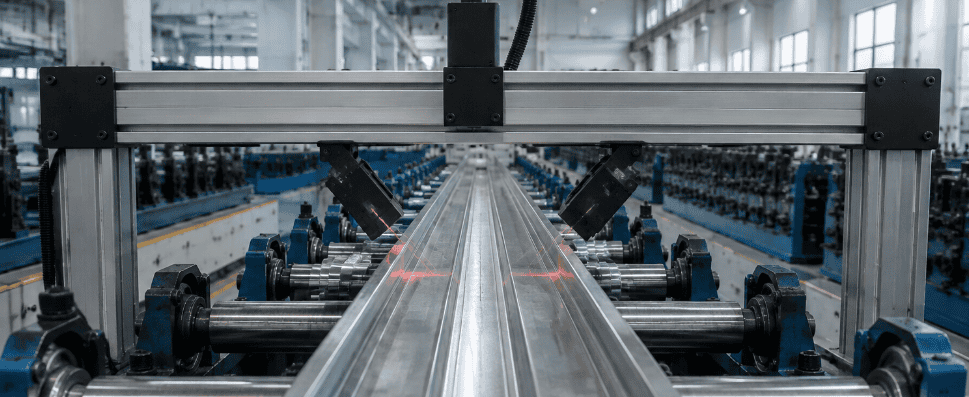
Smart manufacturing continues improving profile quality control.
Emerging technologies include:
- Laser profile scanning
- AI-assisted quality inspection
- Digital twin simulation
- Closed-loop roller adjustment
- Automatic dimensional correction
- Real-time production analytics
These technologies enable manufacturers to detect straightness deviations early and maintain stable production over long manufacturing runs.
Profile straightness is a critical indicator of roll forming quality that directly affects installation performance, customer satisfaction, and production efficiency. Achieving excellent straightness requires more than precise machinery—it depends on proper tooling design, accurate machine alignment, consistent material quality, and disciplined production control, including a clear understanding of how material properties influence forming performance.
Manufacturers that prioritize straightness throughout machine design and production can deliver higher-quality profiles while reducing waste, improving assembly performance, and strengthening long-term customer confidence.
Frequently Asked Questions
Profile bow is usually caused by uneven forming forces, roller misalignment, inconsistent material properties, or improper forming progression.
Yes. Bow is longitudinal bending, while twist refers to rotation of the profile along its length.
Minor deviations may be corrected using straightening equipment, but preventing defects during roll forming is far more efficient.
Yes. High-strength steels generally produce greater internal stress and springback, requiring more precise tooling and machine setup.
Straight profiles simplify installation, improve dimensional consistency, reduce assembly time, and ensure better structural performance.

A great point about the importance of profile straightness in roll forming. Even minor deviations can affect fit, alignment, and overall structural performance. Maintaining precise forming and quality control is essential for achieving consistent, reliable profiles.