

Roll Forming Profile Twist: Causes and Troubleshooting
Troubleshooting Roll Forming Profile Twist in Production
Among the many challenges encountered in metal profile production, profile twisting remains one of the most frustrating because it often develops gradually rather than appearing immediately after equipment startup. A production line may operate normally for several hours before operators begin noticing slight rotation along the finished profile, making the root cause difficult to identify.
Whether producing C and Z structural sections, cable tray components, storage rack uprights, roof panels, greenhouse channels, or drainage profiles, profile twisting can affect downstream assembly, packaging efficiency, and dimensional consistency. The issue is not limited to a particular profile type or material grade. Instead, it usually results from the combined influence of material behavior, tooling conditions, and production settings.
For manufacturers using a roll forming machine as part of a continuous production line, understanding how twisting develops is often more valuable than making repeated roller adjustments without identifying the underlying cause.
Table of Contents
Roll Forming Profile Twisting Is Often the Result of Several Small Variations
Operators frequently assume that twisting originates from one misaligned forming station. While profile alignment in metal production is important, production experience shows that the problem is often cumulative.
Small differences in coil edge condition, entry guiding, roller pressure, or material properties may not be noticeable individually. However, as the strip passes through multiple forming stations, residual stresses can gradually accumulate until the profile begins to rotate.
Material thickness tolerance also deserves attention. Even when steel complies with specification, slight variation across coil width may influence forming forces during long-run operation.
Before adjusting tooling, many experienced manufacturers first verify:
- Coil centering at the entry section
- Side guide alignment
- Material width consistency
- Roller cleanliness
- Bearing condition
- Lubrication status
These inspections often eliminate simple causes before more complex mechanical adjustments become necessary.
Servo Feeding Consistency Should Be Evaluated First
A common troubleshooting mistake is focusing exclusively on the forming section while overlooking material feeding.
If the strip does not enter the first forming station consistently, every downstream station compensates for that deviation. Over hundreds of meters of production, the accumulated effect may appear as profile twist rather than obvious feeding instability.
Modern production lines increasingly incorporate servo feeding systems, precision entry guides, and encoder monitoring to maintain stable strip progression before forming begins.
For production lines integrating hydraulic punching, feeding consistency becomes even more important. Poor synchronization between feeding and punching may introduce localized stress that later influences profile alignment during the forming process.
Although twisting may become visible near the exit of the line, its origin often lies much earlier in the production sequence.
Tooling Wear Can Gradually Change Profile Behavior
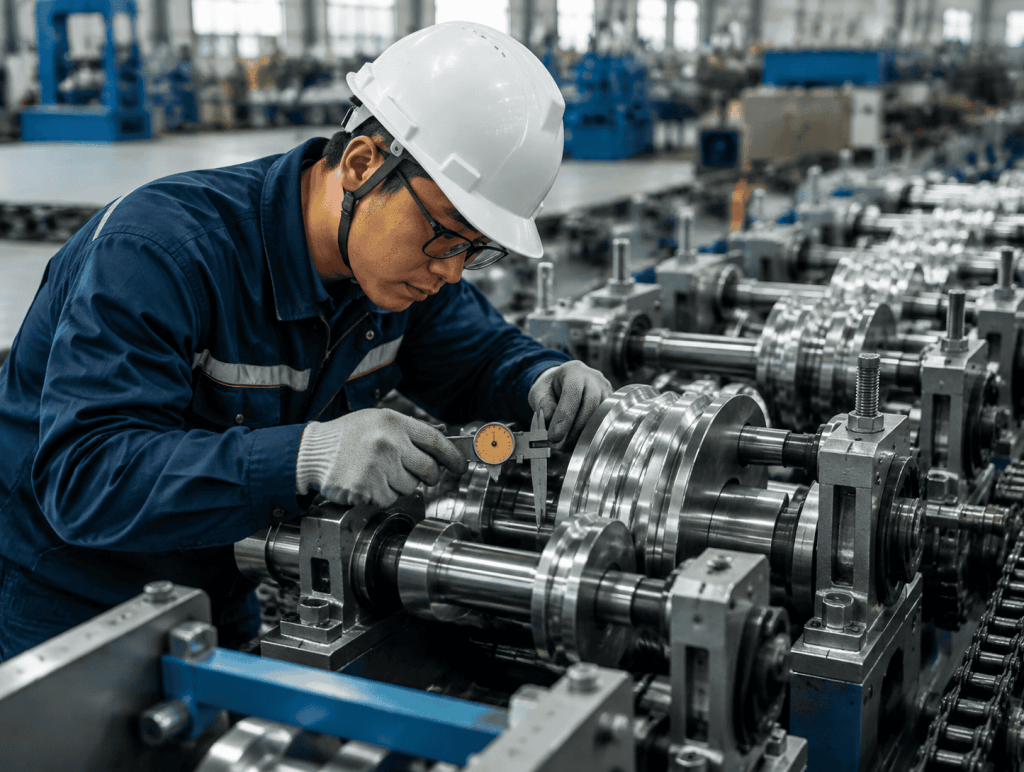
Roll tooling does not usually fail suddenly but when it does, the cold roll forming stability is destroyed.
Instead, roller wear develops progressively, particularly in facilities processing galvanized steel with high production volumes or heavier structural materials.
Uneven roller wear may create small differences in forming pressure between the left and right sides of the profile. Initially, these changes are difficult to detect through visual inspection alone.
Regular dimensional measurement of finished products provides more useful information than waiting until twisting becomes obvious.
Many manufacturers establish preventive maintenance schedules based on production hours rather than waiting for visible tooling damage. Periodic inspection of bearings, shaft rigidity, spacers, and roller surfaces helps maintain stable forming conditions throughout extended production campaigns.
This approach is equally applicable to structural profile manufacturing, such as C and Sigma profiles, cable tray systems, solar mounting rails, and storage rack components.
Equipment Configuration Influences Long-Term Stability
Equipment design also plays an important role in reducing profile variation.
Rigid machine frames, accurately machined shafts, reliable transmission systems, and properly balanced forming stations provide a stable foundation for continuous production.
Automatic stacking equipment and controlled discharge systems contribute as well. Long profiles that leave the forming section without adequate support may appear twisted even when the actual forming process remains stable.

A typical production line designed for structural profiles may include a hydraulic decoiler, leveling system, servo feeding unit, punching section where required, roll forming machine, hydraulic cutting system, and automatic stacking equipment. Each section contributes to maintaining dimensional consistency throughout the production process.
For manufacturers planning sustained production of specialized profiles, equipment suppliers may occasionally cooperate during tooling verification and trial production. These collaborations are generally appropriate for stable manufacturing programs with consistent production demand rather than short-run orders.
Technical guidance published by the International Organization for Standardization and the European Steel Association provides valuable reference information on manufacturing quality, steel materials, and dimensional control that supports continuous process improvement.
Profile twisting is rarely the result of a single adjustment. Successful troubleshooting usually comes from evaluating the entire production process—from coil entry to finished profile handling—rather than concentrating on one station alone.
Frequently Asked Questions
In many cases, twisting develops from multiple small variations in feeding, material behavior, and forming pressure rather than one single fault.
Not always. Entry guiding, coil centering, material consistency, and bearing condition should be checked before modifying roller settings.
Yes. Poor synchronization between feeding and punching can introduce localized stress that later affects profile alignment.
Structural C and Z profiles, Sigma sections, cable trays, storage rack uprights, solar mounting rails, greenhouse channels, and long roofing profiles can all be affected.
Routine inspection of rollers, bearings, shafts, and spacers helps maintain stable forming conditions and reduces gradual dimensional variation. As a result, roll forming profile twist will be minimized.
Yes. Proper profile support after forming helps prevent deformation of long products during discharge and collection.
