

Indian clients visit MTC for the order of stainless steel roll rorming machines
MTC had visitors from India yesterday afternoon for the discussion about the order of stainless steel roll forming machine that will be designed and manufactured for the production of rail coach components, like roofing and flooring etc.
The clients comes from an Indian company that is the manufacturer of rail coach components, like coach roofing, coach flooring and coach wall sheets etc. The first two stainless steel roll forming machines that the clients will order produces the flooring for rail or metro coach; two custom roll forming machine equipments are different because there are two kinds of flooring respectively from 1250mm and 540mm widths stainless steel, and the thickness varies from 1.2-2mm.
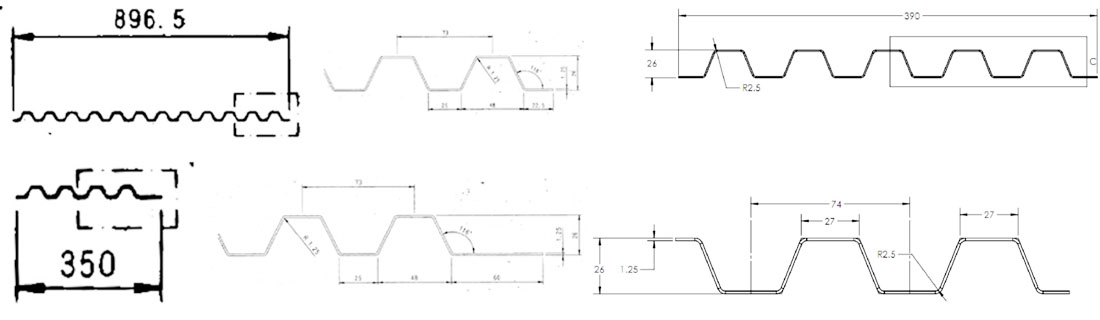
Actually there are 3 different profiles, 896.5, 350 and 390, but the dimension of 350 profile are the same as part of 896.5 profile, so technically one stainless steel roll forming machine will be able to prodcue these 2 profile, and the other one roll forming machine for this customised 390 stainless steel profile is required. The discussed roll forming machine equipment for the custom profiles will be driven with gear-box and universal joint shafts, and separate forming stands will be equipped.
Frequently Asked Questions
What types of stainless steel are commonly used for rail coach roofing and flooring roll forming? ›
For rail coach components like roofing and flooring, stainless steel grades are typically selected based on corrosion resistance, strength, and formability. Common choices include austenitic grades like 304 or 316, depending on the environment and service requirements. The final grade selection depends on your specific application standards and material availability. Your roll forming machine supplier should confirm that the tooling and machine design are compatible with the yield strength and hardness of the stainless steel grade you plan to use.
How does the material width and thickness affect the design of a stainless steel roll forming machine? ›
Material width and thickness are critical inputs because they determine the forming load, the number of forming stations, the power of the drive system, and the rigidity of the machine frame. For the rail coach project described, the stainless steel flooring comes in 1250mm and 540mm widths with thickness varying from 1.2 to 2mm. Wider and thicker material requires more force to form and often needs stronger stands and possibly a higher-tonnage gearbox. The roll tooling profile must also be designed to accommodate the exact material dimensions to avoid defects.
Why might a single roll forming machine be able to produce multiple profiles? ›
In some cases, different profiles share common dimensional features, allowing one roll forming line to produce them with a change in part of the tooling or by stopping at different forming stages. For the Indian client’s order, the 896.5 profile and 350 profile share identical dimensions in one section, so one machine can produce both. The third 390 profile is unique and requires a separate machine. When evaluating a machine, ask whether your intended profiles share enough geometry to be combined, as this can reduce capital equipment costs.
What are the typical machine configurations for custom roll forming lines producing stainless steel rail coach profiles? ›
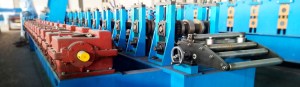
Custom roll forming machines for rail coach profiles are commonly configured with a gearbox and universal joint shaft drive system rather than chain drives. This configuration provides more precise synchronization and higher torque capacity, which is important for stainless steel forming. The machine also uses separate forming stands, meaning each pass has its own housing and adjustable tooling. This setup allows greater flexibility for profile changes and reduces tool wear. Your machine builder should confirm the exact number of stands and drive configuration based on your profile’s complexity and material thickness.
How is the production speed determined for a stainless steel roll forming machine? ›
Production speed is not a fixed number but is influenced by several factors: material thickness and hardness, profile complexity, the number of forming passes, cut-off system design, and downstream handling equipment. For stainless steel with thickness up to 2mm, the machine speed is often limited by the ability to maintain dimensional accuracy and by the cutting operation. Your supplier will calculate a recommended linear speed after analyzing your specific profile and material. Request a speed range for your exact application rather than relying on general machine specifications.
What factors should be considered when ordering custom roll forming equipment for rail coach components? ›
When ordering custom equipment for rail coach parts, provide your supplier with complete profile drawings, including all cross-section dimensions and tolerances. Specify the material grade, width, and thickness range you will process. Also, clarify whether you need punching, notching, or cutting to length performed inline. For the Indian order, a significant consideration is whether one machine can produce multiple profiles, as was possible with the 896.5 and 350 profiles. Discuss electrical supply voltage and frequency early, as this affects motor and control system selection.
Why is a site visit discussed or conducted before finalizing a roll forming machine order? ›
A site visit allows the buyer and the manufacturer to align on technical details that are difficult to convey through drawings alone. During the visit for the Indian rail coach order, MTC and the clients discussed the design of two custom machines producing flooring from different width coils. Visitors can verify the manufacturer’s engineering capability, inspect similar machines in operation, and clarify tooling change procedures. It also helps the supplier understand the client’s production environment and quality expectations. A face-to-face meeting can reduce the risk of miscommunication and supports a more precise quotation.
