

C Stud Roll Forming Machine Completed
C Stud Roll Forming Machine for Galvanized Steel Framing
A C stud roll forming machine is designed to continuously manufacture galvanized steel C studs used in wall framing, partition systems, light steel structures, and sandwich panel frames. By feeding galvanized steel coil through a series of precision forming stations, the machine gradually forms flat strip into the required C-shaped profile and cuts it automatically to preset lengths.
MTC recently completed a customized C stud roll forming machine for a customer in the United States. The machine processes 18–24 gauge galvanized steel and was specifically ordered to produce C studs used as structural framing components inside EPS wall sandwich panels.
Although the customer’s primary requirement is C stud production, the machine is technically capable of producing both C studs and U tracks with the corresponding tooling and setup. For projects requiring both profiles, see our Stud and Track Roll Forming Machine for complete machine configurations.
Project Overview
What Is a C Stud Roll Forming Machine?
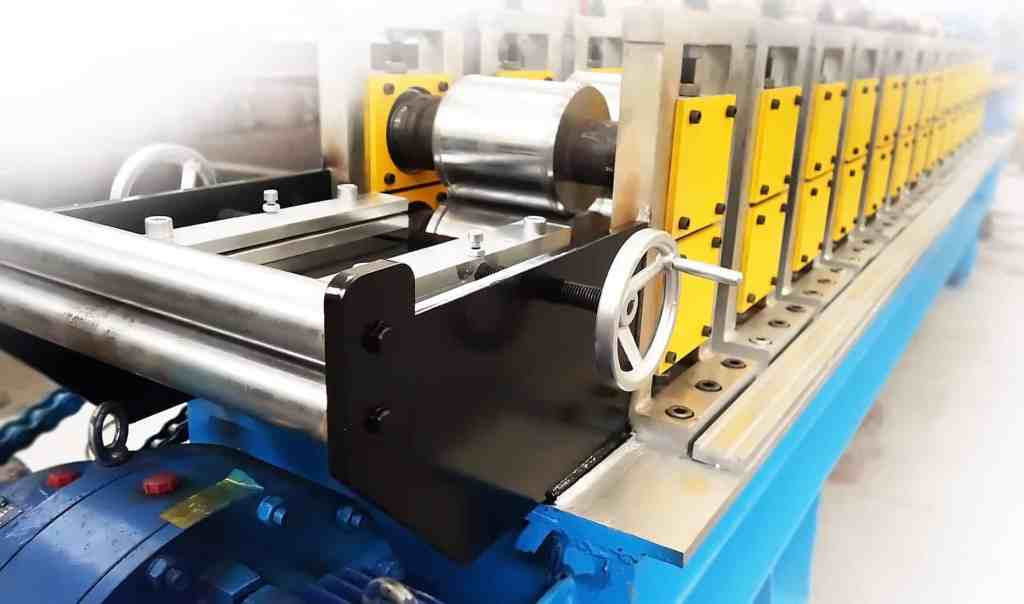
A C stud roll forming machine converts galvanized steel strip into continuous C-shaped framing profiles through progressive cold roll forming.
Instead of forming the complete section in a single operation, multiple roller stations gradually bend the strip until the required web, flange, and lip dimensions are achieved. This progressive forming method helps maintain profile consistency while allowing continuous production at industrial speeds.
A typical C stud manufacturing process includes:
- Coil loading and decoiling
- Material feeding and guiding
- Progressive roll forming
- Profile straightening
- Automatic length measurement
- Hydraulic cutting
- Finished profile collection
Once properly configured, the production process is largely automatic. The operator mainly needs to set the required product length and quantity through the PLC control system.
C Stud and U Track Production
C studs and U tracks are commonly used together in metal framing systems. The C stud normally acts as the vertical framing member, while the U track provides the corresponding horizontal track.
Because their cross-sectional shapes are related, some roll forming systems can be designed to manufacture both profiles. The exact solution depends on the required profile dimensions, material thickness, production volume, and how frequently the operator needs to change between products.
For this particular American project, only C studs are required for production. However, the mechanical design allows the equipment to accommodate U track production when the appropriate configuration is used.
Where frequent production of multiple stud and track sizes is required, a dedicated stud and track roll forming machine with a suitable changeover system may be a better solution.
Material Range: 18–24 Gauge Galvanized Steel
This C stud roll former is designed for galvanized steel from approximately 0.6 to 1.2 mm in thickness, covering the customer’s required 18–24 gauge production range.
Galvanized steel is widely used for framing profiles because the zinc coating provides corrosion protection while the base steel offers the strength required for structural and non-structural framing applications.
However, material thickness alone is not sufficient when designing a roll forming machine. Important information normally includes:
- Material type and steel grade
- Yield strength
- Material thickness
- Strip or coil width
- Required C stud dimensions
- Flange and lip dimensions
- Required length tolerance
- Production speed
These parameters affect roller design, shaft size, motor power, forming stations, and the overall machine configuration.
How Does the C Stud Roll Former Work?
Operating the machine is relatively straightforward once installation and commissioning have been completed.
The galvanized steel coil is first mounted onto the manual decoiler. The strip is then introduced through the feeding and guiding unit before entering the main forming section.
Thirteen forming stations progressively shape the strip into the required C profile. A straightening unit at the outlet helps correct the finished profile before cutting.
Production length and quantity are entered through the PLC control system. During automatic operation, the encoder measures the profile length and the hydraulic cutting unit cuts each C stud according to the programmed dimensions.
The basic operating sequence is:
- Load the galvanized steel coil.
- Feed the strip into the guiding unit.
- Check material alignment.
- Set the required length and quantity through the PLC.
- Run the machine in automatic mode.
- Collect the finished C studs from the exit table.
This makes the C stud production line suitable for continuous and repeatable manufacturing rather than manual profile fabrication.
Main Components of the C Stud Roll Forming Machine
The machine supplied for this project consists of the following major components:
- 1 Ton Manual Decoiler – supports and releases the galvanized steel coil.
- Feeding Unit – guides the strip into the correct position before forming.
- Main Roll Former – progressively forms the flat strip into the required C profile.
- Straightening Unit – assists in maintaining finished profile straightness.
- Hydraulic Cutting Unit – cuts the profile according to the preset production length.
- Hydraulic Station – provides hydraulic power for the cutting operation.
- PLC Control Unit – manages length, quantity, and automatic production.
- Exit Table – supports finished profiles after cutting.
Each component is configured according to the actual profile drawing and production requirements rather than using one fixed machine specification for every project.
Technical Specifications
| Parameter | Specification |
|---|---|
| Machine Type | C Stud Roll Forming Machine |
| Raw Material | Galvanized Steel |
| Material Thickness | 0.6–1.2 mm |
| Typical Material Range | 18–24 Gauge |
| Decoiler Type | Manual Decoiler |
| Decoiler Capacity | 1 Ton |
| Forming Stations | 13 Stations |
| Shaft Diameter | 70 mm |
| Main Motor Power | 7.5 kW |
| Cutting Method | Hydraulic Cutting |
| Hydraulic Power | 3 kW |
| Cutting Blade Material | Cr12 Steel |
| PLC | Panasonic |
| Inverter | Yaskawa |
| Encoder | Omron |
| Standard Machine Input | 380V / 3 Phase / 50Hz |
These specifications relate to this particular machine. A customized metal C stud machine may require different forming stations, motor power, decoiler capacity, control components, or cutting configuration depending on the customer’s profile and material.
Electrical Configuration for the US Market
Electrical compatibility must be considered when a Chinese-manufactured roll forming machine is installed in North America.
This machine is originally designed around a 380V / 3-phase / 50Hz electrical system. The customer’s local power supply is different, so a transformer is supplied as part of the project to provide the required operating voltage.
For this US project, MTC also selected a UL-approved motor according to the agreed electrical configuration.
Before manufacturing a machine for the US market, we therefore confirm the customer’s actual factory power supply rather than assuming that one electrical configuration is suitable for every installation.
Safety Covers and Machine Structure
Moving forming components require appropriate guarding during normal operation. For this machine, protective safety covers are installed around the forming section to reduce direct access to rotating components.
The machine also uses individual forming stands with chrome surface treatment. This construction provides a rigid base for the forming shafts and allows individual stations to be installed and adjusted accurately during machine assembly.
Machine guarding should always be combined with proper installation, operator training, and safe operating procedures. Additional general information about machinery guarding is available from the U.S. Occupational Safety and Health Administration (OSHA).
Applications of Finished C Studs
The C profiles produced by this machine are primarily intended for EPS sandwich panel framing. However, galvanized C studs are also commonly found in other lightweight construction systems.
Typical applications include:
- EPS wall sandwich panel frames
- Interior partition framing
- Drywall framing systems
- Lightweight steel structures
- Modular building components
- Prefabricated wall systems
The required C stud specification varies significantly between applications. This is why the profile drawing and raw material information should be confirmed before determining the final machine configuration.
Choosing the Right C Stud Roll Forming Machine
There is no single machine configuration suitable for every C stud project.
Before designing a C stud roll forming machine, the most important information is the finished profile drawing together with the material width and thickness. If multiple C stud or U track sizes are required, the complete size range should also be provided.
Other requirements such as punching, production speed, automatic size adjustment, cutting method, decoiler capacity, local power supply, and safety standards can then be evaluated.
For customers producing a complete metal framing system rather than a single C profile, our Stud and Track Roll Forming Machine provides more information about machines designed for both stud and track production.
Frequently Asked Questions
What materials can this C stud roll forming machine process? ›
The machine is designed for galvanised steel, with a material thickness range of 0.6–1.2mm (approximately 18–24 gauge). It produces both C stud and U track profiles from the same coil stock, allowing flexibility for wall sandwich panels or light steel framing applications. The specific coil width required will depend on the desired final stud or track dimensions and must be confirmed when configuring your machine.
Can this machine punch holes for services or connections? ›
The standard configuration shown here includes a manual decoiler, feeding unit, main roll former, straightening unit, hydraulic cutting unit, and control system. Punching or notching stations are not listed as included components. If you need holes, slots, or other cutouts added to the profiles, these can be incorporated as optional features. Please discuss your exact punching pattern and location requirements with MTC when requesting a quotation.
What are the electrical and setup requirements for North American operation? ›
This machine ships with a standard electrical input of 380V, 3-phase, 50Hz, which is common in China but not in North America (typically 230V/460V, 3-phase, 60Hz). A step-up transformer or voltage/Frequency converter is required to operate the machine correctly in the US or Canada. Additionally, MTC uses a UL-approved motor on this unit to assist with meeting US safety standards, but local electrical wiring and installation still need to be carried out by a qualified electrician.
What is the manufacturing output or speed of this machine? ›
The page does not specify an exact production speed. In practice, output depends on several factors: material thickness (0.6–1.2mm), profile length, number of punching operations (if any), and the efficiency of the hydraulic cutting cycle. At 13 forming stations with a 7.5KW main motor, typical roll forming speeds for light gauge studs are often in the range of 10–30 metres per minute, but the final figure must be confirmed by MTC based on your profile requirements.
What profiles can be produced, and how is the C stud dimension controlled? ›
This C stud machine is also known as a stud and track roll forming machine because the same line can produce both C stud and U track profiles. Profile dimensions such as web height, flange width, and overall length are determined by the roll tooling and adjustable through the PLC control system. The page only notes that the machine is set for 18–24 gauge steel; for precise profile measurements you should submit your target drawings or dimensions to MTC so they can configure tooling correctly.
What safety features are integrated into this machine? ›
MTC has included a UL-approved motor to meet North American electrical standards, and a safety cover is provided over the rolling tools to protect operators from rotating parts and pinch points. It is important to follow all lock-out/tag-out procedures and use guard interlocks during maintenance. The manual decoiler and hydraulic cutting unit also present potential hazards if handled without proper training, so installation and operation should be completed per the user manual and local safety regulations.
How is the machine controlled, and what do I need to know for day-to-day operation? ›
Operation is largely automated via a PLC control box using Panasonic PLC, Yaskawa inverter, and Omron encoder components. After setting up the machine and selecting the language, you only need to input the required lengths and quantities before switching to automatic mode. The control system also handles the straightening and cut-off timing. For daily use, operators should verify material alignment and adjust the manual decoiler tension to prevent feeding issues.

[…] Two months ago, a client from Arizona in USA ordered this steel stud roll forming machine. Accordingly, it’s ready for shipping punctually. See the specifications at C stud roll forming machine. […]