
Understanding the Strut Channel Roll Forming Machine Cutting Issue and Edge Deformation
The strut channel roll forming machine is an essential piece of equipment for producing C, Z, and U-shaped strut channels used in construction, solar mounting systems, industrial framing, and electrical installations. These machines offer precise roll forming capabilities, allowing manufacturers to produce channels with consistent dimensions, accurate holes or slots, and smooth edges. Despite their efficiency, one common concern reported by operators is cutting-related edge deformation, which can impact product quality, assembly accuracy, and downstream installation.

Today, let’s take a deep look into the strut channel roll forming machine cutting issue, its causes, and practical solutions to minimize or eliminate edge deformation.
Table of Contents
Understanding the Strut Channel Roll Forming Process
A typical strut channel roll forming process involves feeding a metal coil through a series of precision rollers, each of which gradually bends the flat strip into the desired channel profile. Depending on the product requirements, the machine can also perform punching, embossing, labeling, or other operations inline.
One of the critical steps in this process is cutting the channel to the required length. Roll forming machines can use several cutting methods, including:
- Front cutting (pre-cut): Cutting the strip before it enters the roll forming section, usually for shorter channels or batch processing.
- Post-cutting (after forming): Cutting the formed channel to length using either a hydraulic cutter or a fly-saw. Post-cutting is widely adopted because it ensures that the channel length is accurate after all forming operations, especially for longer channels.
Material Thickness Range and Its Impact
Modern strut channel roll forming machines are designed to handle different material thicknesses, typically ranging from 1.5 mm to 2.5 mm. However, many clients request channels made from slightly thicker sheets, up to 3.0 mm. While the strut channel machine can technically accommodate this, varying material thicknesses introduce challenges in cutting, especially when the difference between the minimum and maximum thickness is significant.
In strut channel profiles, the inner radius (R) of the unistrut channel is usually fixed, while the outer radius varies according to the material thickness. When the thickness variation is large, the hydraulic cutter may struggle to cut cleanly, leading to edge deformation at the top and bottom of the channel.
Common Cutting Solutions
There are primarily two types of post-cutting solutions used in strut channel roll forming machines:
1. Hydraulic Cutoff
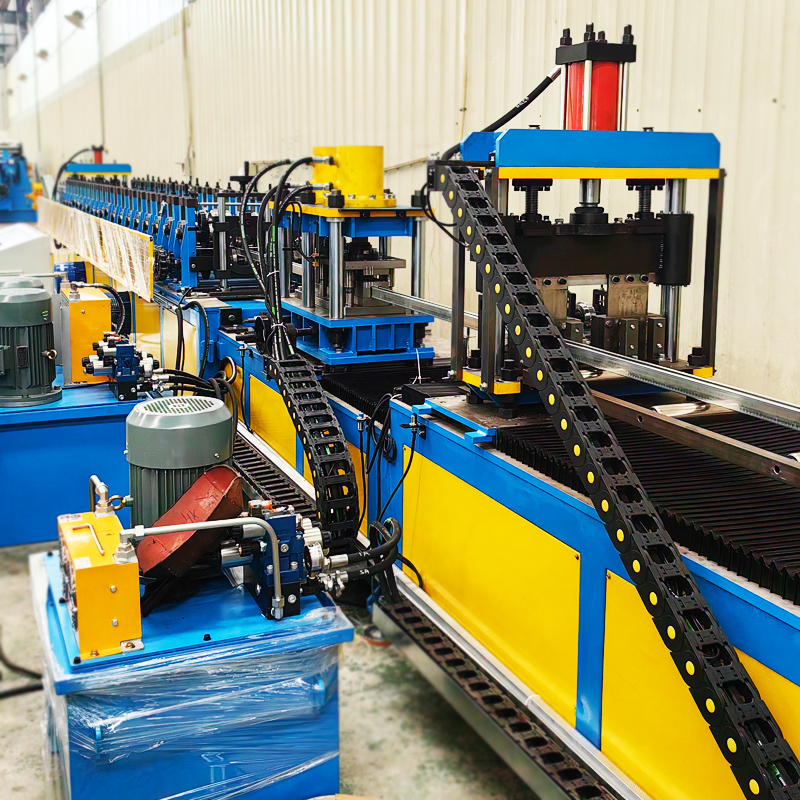
The hydraulic cutter is widely used due to its strength, speed, and suitability for medium to thick materials. It can cut through heavy-duty steel without damaging the rollers or other machine components.
However, edge deformation often occurs in hydraulic cutting under the following conditions:
- Large thickness variation: When the same blade is used for 1.5 mm and 3.0 mm material, the mismatch in outer radius causes stress at the cutting point.
- Blade clearance: If the blade-to-die clearance is not adjusted for the material thickness, the cutting force may bend the edge or create burrs.
- Repeated use: Over time, blades wear unevenly, exacerbating deformation issues.
Solution: The recommended practice is to match a specific blade set to a small material thickness range, ideally within ±0.5 mm. This minimizes the gap between the blade and die, reducing edge deformation. Replacing worn blades promptly is also critical for maintaining consistent cut quality.
2. Fly-Saw Cutter
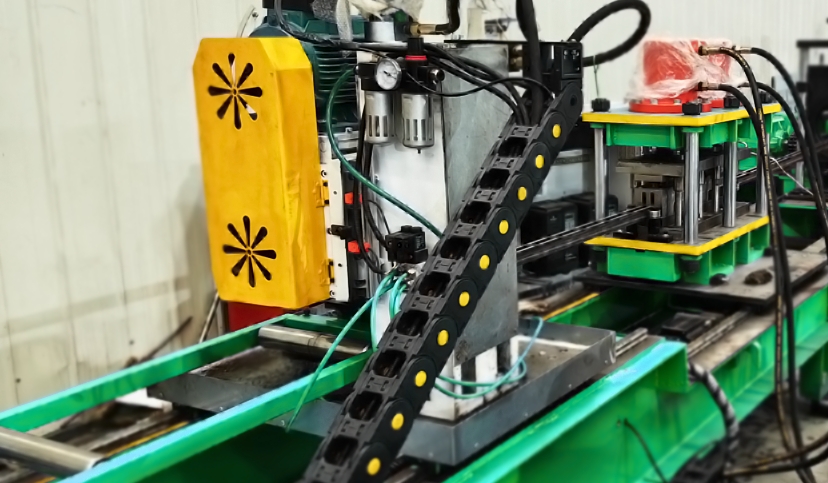
The fly-saw cutter rotates at high speed and cuts the channel while it is moving through the machine, producing a smoother edge in some cases. Fly-saw cutter with a servo tracking system is always used for production of PU metal siding.
Advantages of fly-saw cutting include:
- Reduced edge deformation for certain thickness ranges
- Better performance with thin or delicate materials
However, fly-saw cutters have some limitations:
- Blade wear: Fly-saw blades wear out faster due to high-speed contact, requiring frequent sharpening or replacement.
- Noise and vibration: The cutting process generates more noise compared to hydraulic cutters.
- Burr formation: Over extended production runs, small burrs may appear, which need manual or secondary deburring.
- Cutting speed: While precise, fly-saw cutting is generally slower than hydraulic cutting for thick or long channels.
Why Thickness Matters
To further illustrate, consider a C-type strut channel with a fixed inner radius of 10 mm. For a 1.5 mm material, the outer radius is 11.5 mm, while for a 3.0 mm material, it becomes 13 mm. Using a single cutter set for both thicknesses introduces excessive stress at the edge during cutting, leading to:
- Slight bending at the corners
- Minor burrs along the cut edge
- Occasional cracks or deformation for harder steels
A precise blade-to-thickness match eliminates most of these problems, ensuring the channel meets design specifications and can be assembled smoothly in solar or industrial framing projects.
Practical Tips to Minimize R-angle Deformation
- Use separate blades for different thickness ranges: Maintain a dedicated hydraulic cutter blade set for each material thickness range, ideally within a 0.5 mm deviation.
- Monitor blade wear: Inspect and replace blades regularly to prevent uneven cutting.
- Consider fly-saw cutting for thin or sensitive materials: While slower and noisier, fly-saw cutters can produce cleaner edges for specific thicknesses.
- Adjust cutting parameters: Fine-tune blade clearance and hydraulic pressure based on material thickness and profile type.
- Quality control: Inspect a sample of cut channels from each batch to ensure consistent edge quality before full production.
By implementing these strategies, manufacturers can significantly reduce the incidence of strut channel roll forming machine cutting issues while maintaining high productivity and product quality.
Key Takeways
Edge deformation in strut channel roll forming machines is a common challenge, especially when cutting materials with varying thicknesses. The issue is typically linked to post-cut hydraulic cutting, where mismatched blade clearance and large thickness variation can compromise edge quality. By carefully matching blades to thickness ranges, monitoring wear, and using alternative cutting methods like fly-saw when appropriate, manufacturers can maintain high-quality production standards.
At MTC, we frequently share troubleshooting tips and production insights to help operators optimize their roll forming processes. If you want to stay updated on the latest solutions for strut channel roll forming machine cutting issues, we welcome you to subscribe to our newsletter.