

Uzbekistan Customer Visits to Inspect Rockwool Sandwich Panel Production Line
In the world of modern construction, insulated wall and siding panels are becoming increasingly essential for energy efficiency, fire safety, and long-lasting durability. Yesterday, MTC welcomed a valued customer from Uzbekistan to our factory, where they inspected the running of our advanced Rockwool sandwich panel production line. This visit was not only an opportunity to demonstrate our technology but also a strong testament to the growing demand for high-performance metal siding panels with Rockwool insulation and polyurethane seaming edges in Central Asia.
More simiar information at PU Insulsated Metal Siding Production line.
Table of Contents
Overview of the Rockwool Sandwich Panel Production Line

The showcased rockwool sandwich panel production line was ordered 3 months ago by this customer. It is different from a regular EPS/Rockwool sandwich panel machine, this designed line advanced engineered to produce PU-edge sealed Rockwool sandwich siding panels with the following specifications:
- Panel Type: Metal siding panels with Rockwool insulation and polyurethane seaming edges
- Panel Thickness: 30-50 mm
- Panel Width: 460 mm
- Steel Material: 0.25–0.30 mm pre-painted alu-zinc steel (double-sided)
This rockwool insulated wall sandwich panel production line integrates a combination of mechanical precision and chemical foaming technology to deliver panels that meet international standards for thermal insulation, fire resistance, and mechanical strength. What’s important is the whole rockwool sandwich panel production line is width adjustable and height adujstable to make rockwool insulated wall and siding panel with different thickness and widths.
Key Components of the Line
The Uzbekistan customer was able to see the full sequence of this whole continuous rockwool sandwich panel machine line in operation, including the following equipment:
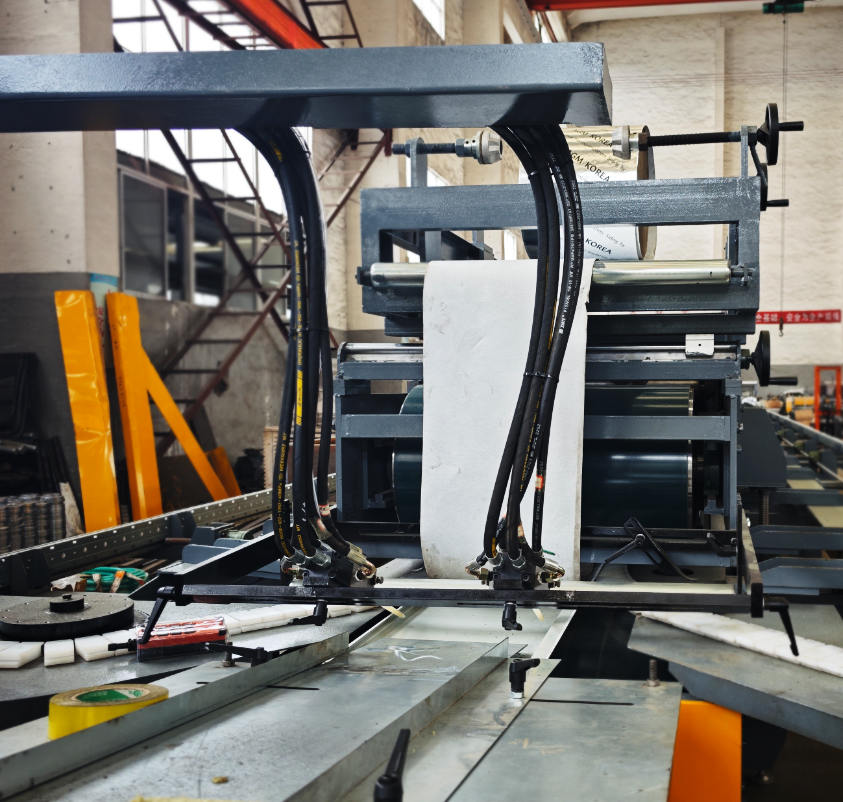
- Two Decoilers
These heavy-duty decoilers feed the steel coils into the line smoothly and continuously, minimizing downtime and ensuring consistent material flow. - Two Roll Forming Machines
Each roll forming machine shapes the steel sheets into the required profile for the sandwich siding panels. The high-precision rollers ensure dimensional accuracy and consistent quality throughout production. - Three-Component PU Foaming Machine
The foaming system consists of three separate chemical components:- Component A + Component B: When combined, these two chemicals create polyurethane foam, which is applied to the edges of the Rockwool sandwich panels. This forms PU seaming edges that improve thermal insulation, prevent water leakage, and ensure airtight joints.
- Component C: This is a specialized industrial adhesive glue, sprayed directly onto the Rockwool or steel sheets. Its role is to improve the bonding strength between the Rockwool core and the steel surfaces, preventing delamination during handling, transportation, or long-term use.
- 32-Meter Lamination Machine
At the heart of this continuous rockwool sandwich panel machine line, this long lamination section ensures that Rockwool insulation, steel sheets, and PU edges are firmly compressed and bonded together. The extended length guarantees stable curing and uniform adhesion. - Fly-Saw Cutoff
The automatic flying saw cuts the finished panels to the desired length with high accuracy, even when the line is running at full production speed.
Production Process

During the inspection, the Uzbekistan customer carefully observed how raw materials are transformed into finished insulated siding panels:
- Steel coils are loaded onto the decoilers.
- Roll forming machines shape the top and bottom steel sheets.
- Rockwool insulation boards are precisely aligned between the two steel layers.
- PU foaming machine applies polyurethane seaming edges while the C-component glue enhances adhesion.
- Lamination machine compresses and stabilizes the panel structure over its 32-meter length.
- Fly-saw cutoff trims the panels to the required size for customer orders.
The end product is a 30 mm thick, 410 mm wide Rockwool sandwich panel with smooth finishing, strong adhesion, and precise dimensions.
Advantages of Rockwool Sandwich Panels
The customer was particularly impressed with the performance benefits of these panels, which are ideal for both industrial and commercial construction projects:
- Fire Resistance: Rockwool core provides excellent fireproof properties, a critical factor in modern building codes.
- Thermal Insulation: The combination of Rockwool and PU edges minimizes heat transfer, improving energy efficiency.
- Sound Insulation: Rockwool’s fibrous structure reduces noise penetration, making the panels suitable for urban and industrial applications.
- Durability: Pre-painted alu-zinc steel offers corrosion resistance, extending the panel’s lifespan even in harsh climates.
- Easy Installation: PU seaming edges ensure tight joints, improving installation speed and reducing thermal bridging.
Customer Feedback from Uzbekistan

The Uzbekistan customer expressed strong confidence in the line’s capabilities. They emphasized that the demand for Rockwool insulated siding panels is rising in their local market, especially for projects requiring fire-rated wall cladding and energy-efficient building envelopes.
The ability to produce panels with both Rockwool insulation and PU edges sealing sets this line apart, combining the best of both materials into one reliable building solution. After the live demonstration, the customer confirmed their satisfaction and showed interest in expanding future cooperation.
Expanding Market Opportunities in Central Asia
The visit highlights the growing influence of MTC in the Central Asian construction industry, where countries like Uzbekistan are experiencing rapid urban development and infrastructure investment. With stricter energy regulations and a shift toward sustainable building practices, Rockwool sandwich panels are becoming a preferred choice for architects, developers, and contractors.
By delivering customized production lines with advanced features, MTC Machinery positions itself as a trusted partner for manufacturers across Asia, the Middle East, and beyond.
Successful Case in Uzbekistan
The successful inspection of our Rockwool sandwich panel production line by the Uzbekistan customer further validates the strength and reliability of our equipment. From decoilers and roll forming machines to the three-component PU foaming system and lamination technology, the line ensures stable performance and consistent output of high-quality insulated siding panels.
As demand for Rockwool insulated siding panels with PU edge sealed continues to grow, MTC remains committed to supporting global customers with advanced solutions for Rockwool Insulated Sandwich Panel Line with Polyurethane Edge Sealing.
FAQ – Rockwool Sandwich Panel Production Line with PU Edge-Sealing
1. What is the main advantage of Rockwool sandwich panels with PU edge sealing?
Rockwool provides excellent fire resistance and thermal insulation, while the polyurethane (PU) edge sealing ensures airtight joints, better waterproofing, and easier installation. This combination delivers panels that meet strict building codes for safety and energy efficiency.
2. What are the typical panel specifications produced by this line?
The production line is designed for panels with a 30 mm Rockwool core thickness and 410 mm width, using 0.25–0.30 mm pre-painted alu-zinc steel on both sides. Length can be customized according to project requirements.
3. How does the three-component PU foaming system work?
The system includes Component A + Component B, which form polyurethane foam for the edge sealing, and Component C glue, which enhances adhesion between Rockwool and steel sheets. This ensures both strong bonding and reliable joint sealing.
4. What equipment is included in the Rockwool sandwich panel production line?
The complete line includes:
- 2 decoilers
- 2 roll forming machines
- 1 three-component PU foaming machine (A+B+C system)
- 1 32-meter lamination machine
- 1 fly-saw cutoff unit
5. What applications are Rockwool sandwich panels commonly used for?
They are widely applied in industrial plants, warehouses, commercial buildings, cold storage, and fire-rated wall cladding systems. The combination of Rockwool and PU edge sealing makes them suitable for projects requiring both fire safety and energy savings.
6. Can the panel thickness and width be customized?
Yes, the production line can be customized to produce different panel sizes depending on the customer’s market demand. The standard demo is 30 mm thickness, 410 mm width, but other options are possible upon request.
7. What is the output capacity of the production line?
Production capacity depends on panel length and line speed. On average, the line can produce several hundred square meters of panels per shift, ensuring reliable output for medium to large-scale projects.
8. What kind of after-sales support is provided?
We provide on-site installation and commissioning, operator training, and long-term technical support. Remote assistance and spare parts supply are also available to keep your production running smoothly.