
Are you ready to roll by your own cold roll former?
Complete Guide for Construction Companies, Contractors, and Metal Product Manufacturers
A cold roll former is a type of metal rollforming equipment that continuously produces metal profiles from steel coils. Whether you need metal floor decking, stud and track profiles, roof flashings, or other products, owning your own machine can transform your business.
This guide will help you decide whether investing in a cold roll forming machine is the right move — and how to choose the best model for your needs. There is another article regarding what a cold roll forming machine is and can makes cold roll forming machine report.

Table of Contents
Real-World Example: Turning Costs Into Profits

When Mr. Gaby Barakat, a US-based construction company owner, visited MTC, his mission was clear:
“I am in the construction business and I use a lot of decking panels like this. Therefore, I believe it’s the right call to get a cold roll former to produce the decking panels on my own.”
Gaby also needed a stud and track roll forming machine to meet his growing demand. By producing metal floor deck panels and other profiles in-house, he avoided high supplier costs and lead times.
“Apart from my own use, I can also sell the decking panels to many other people I know,” he added.
Today, Gaby serves both his own projects and a network of contractors — increasing profit margins and gaining market advantage.
Why Cold Roll Former Insights Are Essential

Understanding cold roll forming machines is the first step toward making a smart investment.
Key benefits include:
- Lower production costs compared to buying finished products.
- Faster project turnaround with on-demand manufacturing.
- Customization control over sizes, coatings, and features.
- New revenue streams from selling excess production.
- Competitive advantage in pricing and delivery times.
If you have consistent demand for products like IND panels, purlins, or roof flashings, a cold roll former can quickly pay for itself.
Factors to Consider Before Buying a roll forming machine
Before purchasing, think about:
- Product range – Will you produce metal floor decking, C/Z purlins, or roof panels?
- Production speed – Do you need a high-speed line for mass output?
- Extra features – Punching, embossing, or label printing may be essential.
- Budget – Avoid expecting a “European machine at Indian prices.”
- Future flexibility – Consider quick-change designs for multiple profiles.
Key Components of Roll Former Machines

A standard cold roll forming line includes:
- Decoiler – Holds and unwinds the steel coil.
- Feeding unit – Aligns the material.
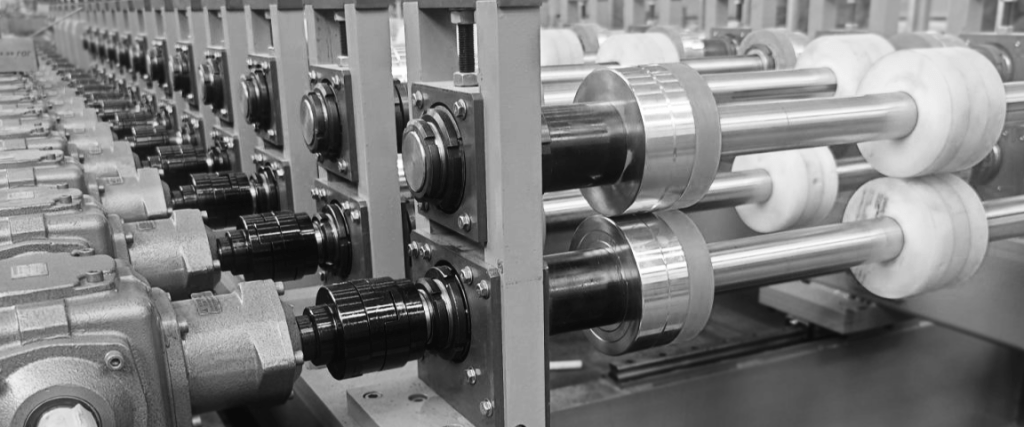
- Roll forming unit – Shapes the profile through consecutive forming stations.
- Punching/Notching station – Adds holes or slots.
- Cutting unit – Hydraulic or flying shear for precise lengths.
- Output table – Collects finished profiles.
- Control system – PLC for automation and accuracy.
Extra modules may include embossing stations, in-line printing, or quick-change tooling.
How Manufacturers Design Cold Roll Formers
The design depends on your production requirements:
- Traditional C purlin roll forming machine – Lower cost, slower changeover.
- Quick-change C/Z roll forming machine – Higher cost, rapid size adjustments.
Always provide your manufacturer with profile drawings, material specs, thickness range, and daily output targets to ensure the design matches your needs.
How Quality Machines Are Built
Machine quality depends on:
- Frame strength and welding – Ensures stability.
- Roller material and heat treatment – Increases tool life.
- Drive system – Gearbox or chain options for different budgets.
- Surface treatment – Painting and anti-corrosion coating for durability.
MTC® uses CNC machining for rollers, applies protective coatings, and conducts full test runs before delivery.
ROI: When the Machine Pays for Itself
If you buy metal floor decking at $20/m² but produce it for $14/m², and make 50,000 m² per year, you save $300,000 annually — meaning your metal floor decking machine could pay for itself in 1–2 years.
Add in extra sales from stud and track profiles, roof flashings, or purlins, and the return on investment can be even faster.
Is It Time to Buy Your Own Cold Roll Former?
If you:
- Have consistent or growing demand,
- See potential to sell to others, and
- Can invest in quality equipment,
then a cold roll forming machine is a profitable, strategic investment.
Frequently Asked Questions (FAQ)
Q1: What is a cold roll former?
A cold roll former is a metal rollforming machine that continuously shapes steel coils into specific profiles such as metal floor decking, studs and tracks, or purlins. It can also perform additional tasks like punching, cutting, and embossing.
Q2: Why should I consider buying my own cold roll former?
Owning a cold roll former reduces production costs, speeds up project timelines, and allows you to customize profiles. It also opens new revenue streams by selling excess products like roof flashings or IND panels.
Q3: What products can I produce with a cold roll forming machine?
You can produce metal floor decking, stud and track profiles, C/Z purlins, roof panels, and other customized metal profiles depending on the machine configuration.
Q4: What are the main components of a cold roll former?
A typical line includes a decoiler, feeding unit, roll forming unit, punching/notching station, cutting unit, output table, and PLC control system. Optional modules include embossing or label printing stations.
Q5: How is a quick-change roll forming machine different from a traditional machine?
A quick-change roll forming machine allows faster tooling and profile changeover compared to a traditional line, which saves time when producing multiple profile types like C purlins or Z purlins.
Q6: How do I choose the right roll forming machine supplier?
Select a manufacturer with proven experience, good quality standards, and the ability to customize the machine according to your profile drawings, material thickness, and production volume.
Q7: Can I produce roof flashings and other small parts with one machine?
Yes, with the proper tooling and optional modules, a cold roll former can produce roof flashings, edge trims, and other secondary components much faster than manual methods.
Q8: What is the typical ROI for a cold rollforming machine?
The return on investment depends on your production volume and material costs. Producing metal floor decking or studs and tracks in-house can save 30–40% compared to buying from suppliers, allowing the machine to pay for itself in 1–2 years.
Q9: Do I need additional machines to work with a cold roll forming equipment?
Optional auxiliary equipment may include decoilers for different coil sizes, stacking tables, or in-line punching units. For large-scale production, consider combining with stud and track roll forming machines.
Q10: How long does it take to start producing with a new roll forming machine?
Once installed and calibrated, a cold roll former can start production within days. Training and initial test runs ensure proper operation for producing metal floor decking, C/Z purlins, or other profiles.
For over 20 years, MTC® has supplied metal floor deck roll forming machines, stud and track roll forming equipment, c/z purlin roll forming equipment, and quick-change roll forming machines worldwide.
Contact us today to choose the right machine for your business and start producing with confidence.