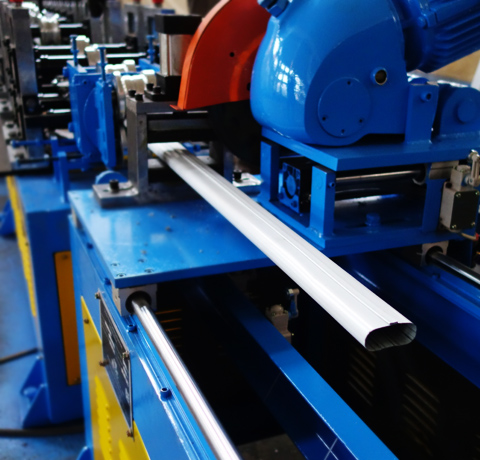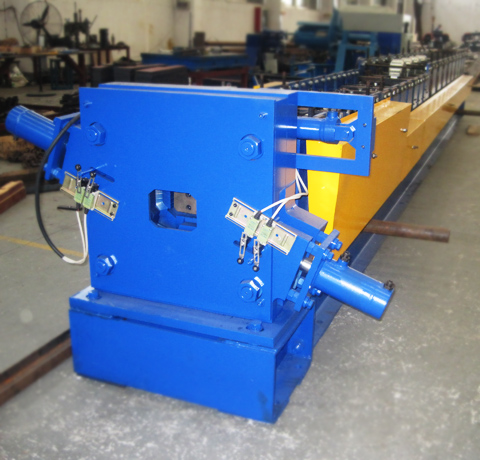
Applications: Rainwater drainage systems, gutter downpipes
Explore the common questions and answers about Tube and Steel Pipe Making Machines
A: A tube and pipe making machine is an automated production line that forms metal coils into hollow profiles. On this page we cover machines for oval pipe roll forming, octagonal pipe roll forming, and downspout roll forming (square/round). Each line is configured with dedicated rollers and cutters to produce the corresponding profile with stable dimensions.
A: No. A single downspout roll forming machine is designed to produce only one specific pipe shape and size — either square or round, depending on your order. If both types are needed, we recommend purchasing two separate forming lines or using interchangeable roll sets with manual adjustment, though this will require downtime for tooling replacement.
A: We offer multiple cut solutions: servo flying shear (flying saw) for continuous, burr-free cutting at high speed (ideal for slotted/continuous pipe production), and hydraulic cut-off for intermittent lines. Servo tracking ensures precise length control and minimal material waste.
A: All lines use PLC control with HMI, encoder feedback for length accuracy, and optional servo feeding. Advanced packages include remote diagnostics, batch recipes, automatic coil change, and material-end detection to support fully automated production workflows.
A: Our oval pipe roll forming machine and octagonal pipe roll former typically process galvanized steel with thicknesses from 0.4 mm to 1.2 mm (model-dependent). For heavier octagonal shafts used as shutter cores we commonly recommend 0.8–1.2 mm for optimal strength and longevity.
A: Yes. For production flexibility we provide options for inline automatic feeding and punching before forming, as well as online bending and necking modules for square/rectangular pipes. Alternatively, stand-alone bending & necking machines are available if you prefer separate post-forming operations.
A: Yes — particularly for thin pre-painted or high-speed lines we provide a circulating water cooling system at the forming section. Cooling stabilizes roller temperature, prevents paint/finish damage, and maintains dimensional accuracy during long production runs.
A: Choose based on end-use and material spec: use oval pipe roll forming machine for cable trunking and decorative conduits; octagonal pipe roll former when you need strong shutter cores/shafts (0.8–1.2 mm); and downspout roll forming machine for rainwater systems (square or round profiles). Also consider required throughput, need for inline punching/bending, and cutter type (flying shear vs hydraulic) when selecting the right tube & pipe making solution.





That’s right! Don’t want to miss out new machines launched, local events, special offers? Sign up to our emails to be notified of the first update.
We will use the information you provide on this form to be in touch with you and to provide updates and marketing. Your privacy will be well protected!