How to Control Panel Twisting in Trailer-Mounted Roof Panel Roll Forming Machines
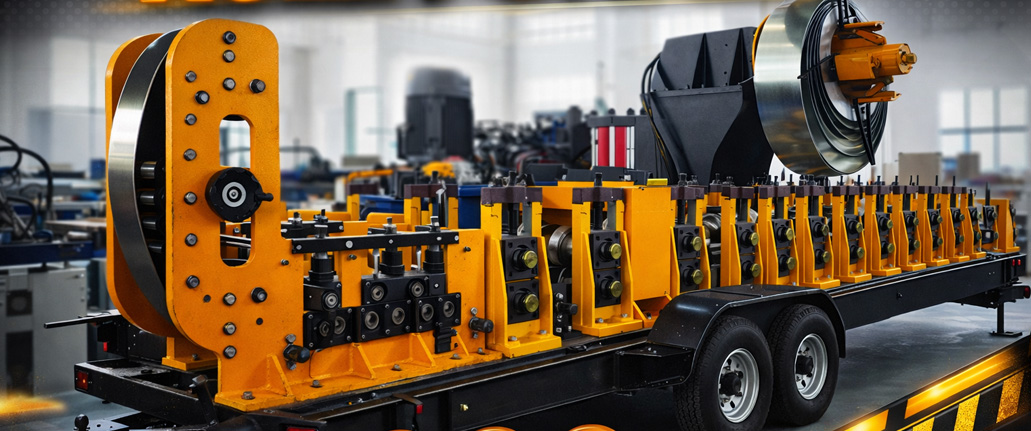
Panel twisting in on-site roll forming! In modern construction projects, on-site roll forming has become an increasingly popular solution, especially for long-span metal roofing systems. Trailer-mounted roof panel roll forming machines allow contractors to produce panels directly at the job site, eliminating transportation limitations and reducing material waste. However, one of the most common technical challenges faced during mobile roll forming production is panel twisting and camber.
Panel twisting not only affects the appearance of roof panels but also creates serious installation problems. Misaligned panels can cause poor joint sealing, uneven fastening, and increased labor time on site. For this reason, controlling twisting or mobile roll forming machine straightness control is a key performance indicator for any high-quality trailer-mounted roll forming machine.
Table of Contents
Understanding Panel Twisting in On-Site Roll Forming

Panel twisting refers to a condition where a roll formed roof panel rotates slightly along its longitudinal axis, causing one edge to sit higher or lower than the other. Camber, which often occurs at the same time, describes a sideways curvature where the panel bends left or right instead of remaining straight.
In on-site production, these defects become more visible because:
- Panels are often produced in long continuous lengths
- Products are installed immediately after forming
- There is little opportunity for secondary straightening
Twisting problems are most commonly observed in standing seam roof panels, trapezoidal roofing sheets, and other profiles with asymmetric geometry.
Why Trailer-Mounted Roll Forming Machines Are More Sensitive to Twisting
Compared with fixed factory roll forming lines, trailer-mounted machines operate under different conditions. Mobility and compact design are essential, but these features also introduce additional technical challenges.
Lightweight Structure and Frame Stability
A mobile roll forming machine must balance portability with rigidity. If the machine frame is not sufficiently reinforced, slight deflections can occur during operation. Even minimal frame movement can affect roller alignment and lead to uneven forming forces across the strip width.
This is why structural design plays a critical role in preventing twisting, especially when forming long roof panels on site.
Root Cause 1: Unbalanced Roll Forming Pass Design
One of the most common causes of panel twisting is an unbalanced roll forming design. When deformation is applied unevenly across the material width, internal stress accumulates and is released as twisting after the panel exits the forming section.
Typical design-related issues include:
- Excessive bending in early forming stations
- Asymmetric profiles without compensation
- Too few forming passes for complex roof panel shapes
In a properly engineered roll forming machine, bending angles are introduced gradually, and forming pressure is distributed evenly. Trailer-mounted roof panel roll forming machines require even more careful roll design due to their compact station layout.
Root Cause 2: Roller Alignment and Setup Accuracy
Even the best roll design cannot perform properly without precise alignment. Roller misalignment is a major contributor to twisting and camber, particularly in mobile machines that are frequently transported and reinstalled.
Common alignment problems include:
- Shafts not perfectly parallel
- Unequal vertical roller gaps
- Side guides pushing the strip off center
During on-site setup, operators may focus on achieving the correct profile shape while overlooking straightness. This often results in panels that look correct in cross-section but twist along their length.
Regular alignment checks are essential for maintaining stable production quality.
Root Cause 3: Coil Stress and Material Characteristics
Steel coils inherently contain residual stress from rolling, slitting, leveling, and coating processes. When these stresses are released unevenly during roll forming, twisting becomes unavoidable.
This issue is more pronounced when using:
- High-strength steel or aluminum alloys
- Thin-gauge materials
- Narrow slit coils taken from wide master coils
In mobile roof panel production, where material batches may vary from project to project, understanding coil behavior is critical for consistent results.
Root Cause 4: Insufficient Exit Support During On-Site Production
Unlike factory environments, construction sites often lack stable and level surfaces. Without proper exit support, long roof panels may twist under their own weight immediately after forming.
This is especially problematic for:
- Long-span roof panels
- Thin-gauge materials
- Profiles with open or asymmetric shapes
Gravity alone can introduce camber if panels are not adequately supported after leaving the roll forming machine.
Practical Solutions for Reducing Twisting in Trailer-Mounted Roll Formers

Optimized Roll Design for Mobile Applications
High-quality trailer-mounted roll forming machines use roll tooling specifically designed for on-site production. Gradual forming, stress balancing, and compensation for asymmetric profiles are essential elements of this design approach.
Effective strategies for managing panel twisting in on-site roll forming can lead to smoother construction operations.
Rigid Yet Lightweight Machine Structure
A well-designed mobile roll former uses reinforced forming sections to maintain rigidity while keeping overall weight suitable for towing. Structural stability ensures consistent roller alignment even when operating on uneven ground.
Precise Roller Adjustment and PLC Control
Modern trailer-mounted roll forming machines are equipped with PLC control systems that provide stable speed control and repeatable forming parameters. Operators simply input the required panel length and quantity, reducing human error and improving consistency.
Proper Exit Tables and Side Supports
Exit supports are not optional accessories in on-site production. Adjustable exit tables and side guides help maintain panel straightness and prevent twisting before cutting.
Long-Term Benefits of Controlling Panel Twisting
Solving panel twisting in on-site roll forming issues delivers long-term benefits beyond improved appearance. Straight panels:
- Install faster and more accurately
- Improve roof sealing performance
- Reduce rework and material waste
- Enhance customer confidence and project efficiency
For contractors and manufacturers alike, stable on-site roll forming directly translates into higher productivity and profitability.
FAQ: Panel Twisting in Trailer-Mounted Roll Forming Machines
Q1: Is panel twisting unavoidable in mobile roll forming?
No. With proper roll design, machine rigidity, and correct setup, trailer-mounted roll forming machines can achieve excellent straightness.
Q2: Does machine relocation affect twisting?
Yes. Transportation may slightly affect alignment, which is why setup checks are essential after each relocation.
Q3: Can PLC automation eliminate twisting?
PLC systems improve consistency but must be combined with correct mechanical design and setup to fully control twisting.
Q4: Are thin roof panels more likely to twist?
Yes. Thin-gauge materials are more sensitive to uneven stress and require careful forming and support.
Q5: Should exit supports always be used on site?
Yes. Proper exit support is critical for maintaining straightness in long roof panels during on-site production.