
C/U/G Solar Channels vs Unistrut Solar Channels: Why There Is No Standard Solar Mounting Frame
The renewable energy sector continues to expand rapidly, and solar mounting systems are a critical part of every project. While C/U/G solar channels and Unistrut solar channels are among the most commonly used profiles, one fact stands out: there is no global standard for solar mounting frames.
This creates both challenges and opportunities for manufacturers. On the one hand, customers demand custom-tailored designs for their projects. On the other hand, roll forming equipment manufacturers can provide flexible machines to produce multiple channel types that meet diverse requirements.

Table of Contents
Why Are There No Standard Solar Mounting Frames?

Unlike standardized construction materials, solar mounting structures must adapt to:
- Climate & Load Conditions
- Snow load, wind pressure, and seismic activity determine frame strength.
- Coastal projects may require thicker anti-corrosion coatings.
- Solar Panel Dimensions
- Panel sizes range from 166mm cell modules to large 210mm cell modules.
- Mounting rails must align precisely with module length and width.
- Project Type
- Rooftop projects need lightweight, flexible channels.
- Utility-scale solar farms require heavy-duty C/G channels for ground mounting.
- Regional Standards
- Each market (U.S., EU, Middle East, Asia) has its own codes for wind/snow load.
Because of these variations, there cannot be a universal “one-size-fits-all” mounting frame. Instead, manufacturers produce different types of solar channels depending on customer requirements.
Types of Solar Channels
1. C/U Solar Channels

- Shape: Traditional C-shaped or U-shaped cross section.
- Size Range: 80-300*40-80mm.
- Thickness: 1.5–3.0 mm typical, up to 4.0 mm for heavy-duty.
- Material: Hot-dip galvanized steel, aluminum-zinc coated steel, stainless steel.
- Applications: Ground-mounted solar farms and large commercial projects.
- Advantage: High load-bearing strength and simple assembly.
2. G-Type Solar Channels
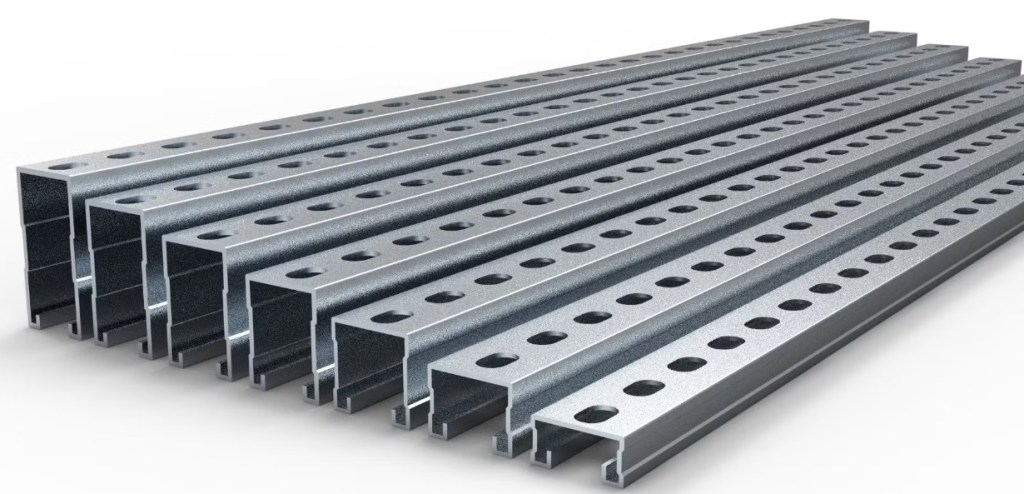
- Shape: Similar to the letter “G” with additional flanges for reinforcement.
- Size Range: 41x82mm, 50x100mm, etc.
- Thickness: 1.8–3.5 mm.
- Material: Galvanized steel with AZ100–AZ275 coating.
- Applications: Utility-scale solar projects requiring stronger support.
- Advantage: Superior rigidity compared to standard C/U channels.
3. Slotted Unistrut Channels
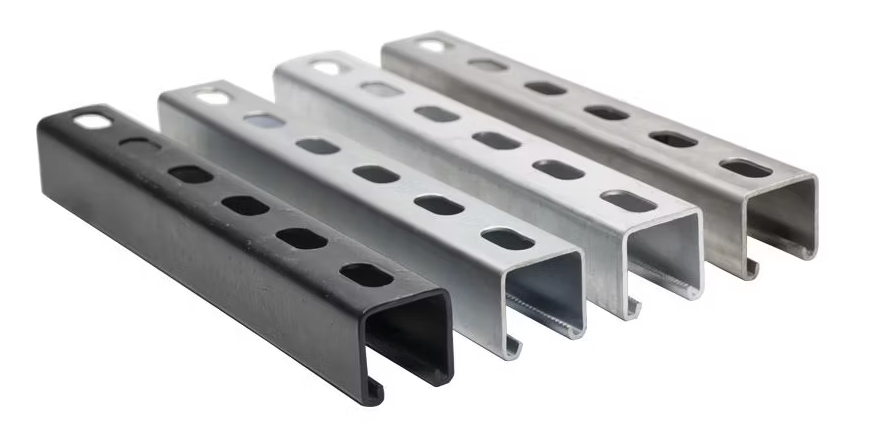
- Shape: Strut channel with pre-punched slots or holes.
- Size Range: 41x21mm, 41x41mm, 41x62mm, etc.
- Thickness: 1.5–2.5 mm.
- Material: Galvanized or stainless steel.
- Applications: Rooftop solar, carports, modular structures.
- Advantage: Quick installation and adaptability with multiple accessories.
Roll Forming Machines for Solar Channels
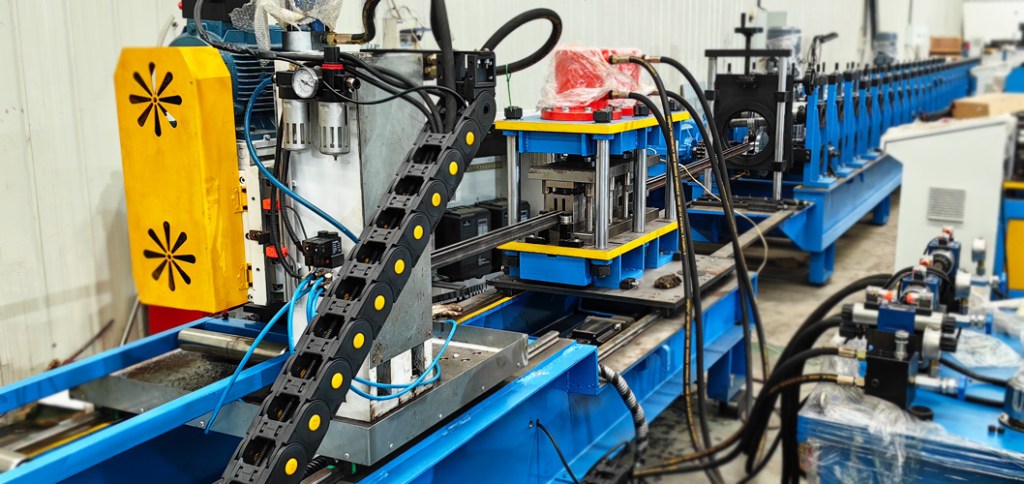
C/U Solar Channel Roll Forming Machine
- Produces multiple sizes of C and U channels with quick-change tooling.
- Integrated punching units for bolt holes or slots.
- Handles coil thicknesses from 1.5–4.0 mm.
- Suitable for GI, stainless, or AZ coated materials.
- High-speed production: 10–20 m/min with PLC & HMI control.
G-Type Solar Channel Roll Forming Machine
- Heavy-duty structure for thicker material (up to 3.5 mm).
- Designed for profiles requiring additional flanges and bends.
- Can integrate embossing or ribbing for added strength.
- Ensures dimensional accuracy for long-span ground-mount systems.
Slotted Strut Channel Roll Forming Machine
- Equipped with pre-punching system for slots.
- Multiple slot patterns programmable in PLC.
- Produces unistrut sizes 41×21, 41×41, 41×62, etc.
- Used for both solar and general construction support systems.
Why Invest in Solar Channel Roll Forming Machines?
- Flexibility: Produce C, U, G, or Unistrut channels for different markets.
- Efficiency: Continuous automated production with low scrap rate.
- Customization: Machines designed to local project standards.
- Durability: High-strength steel rollers and robust frame for long-term use.
- Market Reach: Meet demands of both solar EPC contractors and general builders.
Ready to Get Your Own Solar Channel Roll Forming Machine?
The absence of standardization in solar mounting frames is a reflection of diverse project requirements worldwide. Whether it is C/U channels for general support, G-type channels for heavy loads, or Unistrut channels for flexible modular installations, every profile has its place in the industry.
For manufacturers, the key to success is investing in advanced roll forming machines capable of producing all these profiles with precision and efficiency. Buy a solar strut channel roll forming machine and this not only meets global solar market needs but also ensures competitiveness in the growing renewable energy sector.
FAQs on Solar Channel Roll Forming Machines
1. What materials are commonly used for solar channels?
Most channels are made from galvanized steel (GI), aluminum-zinc (AZ100–AZ275), or stainless steel for high-corrosion areas.
2. What thickness range can solar channel roll forming machines process?
Machines typically process 1.5–2.5 mm coils, with heavy-duty models handling up to 3.0 mm.
3. Can one roll forming machine produce C/U, G, and Unistrut channels?
Not usually. While C/U and G channels can sometimes be produced on one line with tooling changes, Unistrut requires a dedicated punching system.
4. What is the typical size range of Unistrut solar channels?
Common sizes include 41×21 mm, 41×41 mm, and 41×62 mm, with thickness 1.5–2.5 mm.
5. How fast can unistrut channel making machines run?
Depending on punching complexity, speeds range from 10–20 meters per minute.
6. Do these machines include inline punching?
Yes, punching units can be integrated before or after forming to create slots or holes.
7. What advantages do G-type channels offer compared to C/U channels?
G-type channels provide greater rigidity and load capacity, ideal for large-scale ground-mounted projects.
8. How long does it take to manufacture and deliver a solar channel roll forming machine?
Standard delivery is 60–90 days, depending on customization requirements.





[…] essential, how it compares to other common profiles like C channels and U channels (More details at C/U/G Solar Channels vs Unistrut Solar Channels: Why There Is No Standard Solar Mounting Frame), and how our roll forming machine offers unmatched advantages in solar support frame […]