A Safety Door Frame is a robust structural component designed to support and secure high-strength doors used in security, fire protection, and industrial environments. As shown in the image, the frame is formed from high-quality galvanized or cold-rolled steel with precisely engineered profiles that ensure both rigidity and accurate alignment during installation.
The cross-sections of the frame display multiple reinforcement ribs and folded edges, which greatly enhance its load-bearing capacity and resistance to deformation. The integrated hinge positions and mounting holes are designed for quick installation and strong anchoring to the wall structure.
This type of door frame is commonly used in:
Main Features:
Manufactured on a Safety Door Frame Roll Forming Machine, each frame is produced with consistent accuracy and efficiency. The roll forming process ensures uniform shape, excellent surface finish, and minimal material waste, making it ideal for mass production of standardized and high-quality steel door frames.

A Safety Door Frame Roll Forming Machine is specialized equipment designed for producing various types of steel door frames used in residential, commercial, and industrial buildings. These frames are essential components for security doors, fireproof doors, and interior steel doors, providing strength, precision, and long service life.
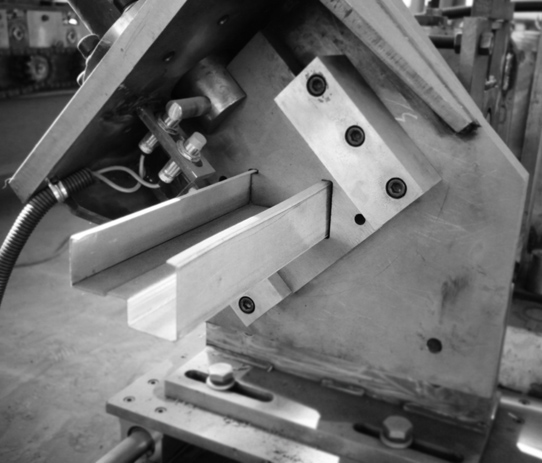
A complete door frame roll forming line generally includes a decoiler (manual or hydraulic optional), feeding guide, roll forming section, 45-degree hydraulic cutting unit, PLC control cabinet, hydraulic system, and run-out tables for collecting finished frames. The configuration ensures stable operation, high accuracy, and smooth edge finishing during production.
The forming section can be designed with either a wall plate frame structure or a portal (housing stands) frame structure, depending on the customer’s preference and required production strength. The transmission system is available in chain drive or gearbox drive, with the latter offering higher precision and smoother synchronization for heavy-duty or high-speed lines.
Common materials used for door frame production include galvanized steel, cold-rolled steel, or stainless steel, typically with a thickness range of 0.8–1.5 mm. Depending on the model and tooling design, the machine can produce various door frame profiles with optional lock holes, hinges, or welding grooves pre-punched automatically.
Our safety door frame roll forming machines are engineered to deliver high efficiency, precision, and long-term reliability. Depending on your production needs and budget, we offer both standard configurations and advanced high-end solutions.
Our machines can produce various door frame specifications with simple parameter input.
This greatly improves productivity and minimizes labor costs.
Cost-Effective and Practical
The standard roll forming line includes:
This setup provides an economical solution for small to medium-scale production. However, wear on certain components may occur faster than with enhanced configurations.
Higher Precision & Longer Service Life
For customers seeking superior speed, accuracy, and durability, we provide upgraded system options:
With these upgrades, the entire production line becomes more stable, resulting in:
Longer equipment lifespan
Higher dimensional accuracy
Better repeatability
Lower maintenance requirements
The following technical specifications represent the standard configuration of our steel door frame roll forming machine. Customized designs are available to accommodate different door frame profiles, material types, and production requirements. MTC provides fully tailored solutions for residential, commercial, and industrial steel door frames, ensuring high precision, stability, and long-term performance for various architectural and construction applications.
| Parameters | Specification |
|---|---|
| Applicable Material | Galvanized Steel |
| Material Thickness | 1.2 – 2.0 mm (customizable) |
| Coil Width | According to door frame profile |
| Machine Speed | 10–15 m/min (depending on punching/ notching requirements) |
| Decoiler | Manual decoiler, 1.5–3 tons (optional motorized decoiler) |
| Leveling System | Standard 3–5 roller leveling (optional integrated decoiling + leveling system) |
| Punching / Notching | Integrated hydraulic punching & notching (optional servo punching unit) |
| Forming Stations | 16–20 stations (depending on profile) |
| Forming Structure | Wall-plate structure (optional independent arch/gantry stands) |
| Transmission | Chain drive (optional gearbox drive) |
| Roller Material | GCr15 with heat treatment & hard chrome coating |
| Shaft Diameter | 75 mm (depending on profile) |
| Cutting System | Hydraulic post-cutting (optional flying cutting system) |
| Control System | PLC with touch screen, profile parameters input & automatic length control |
| Operation Mode | Fully automatic; 1 operator is sufficient |
| Hydraulic System | 7.5 kW (adjustable based on punching requirements) |
| Main Motor Power | 7.5 kW (depending on design) |
| Power Supply | 380V / 50Hz / 3Ph (or customized for Canada, USA, EU etc.) |
| Machine Length | Approx. 9–12 meters (depends on configuration) |
| Optional Upgrades | Servo punching, servo notching, gearbox drive, gantry structure, integrated decoiler + leveler |
Explore the common questions and answers about steel door frame making machines
A: Our machine can work with galvanized steel, cold-rolled steel, stainless steel, and other customized materials. Material thickness typically ranges from 0.6–2.0 mm depending on the profile requirements.
A: Absolutely. We can design roll tooling based on your drawings, samples, or engineering specifications. Custom solutions are available for residential, commercial, and industrial steel door frame systems.
A: The line is fully automated and typically requires only one operator. During coil loading or startup, an additional person may assist for improved safety and efficiency.
A: Standard production time ranges from 60–75 days, depending on customization level, tooling complexity, and optional upgrades.
A: Yes. The PLC control system allows operators to input door frame dimensions directly on the touchscreen. The line automatically adjusts for punching, notching, forming, and cutting, enabling flexible production of multiple frame sizes.
A: Standard speed is 10–15 m/min, depending on punching and notching complexity. With servo punching and gearbox drive systems, higher speeds can be achieved.
A: Upgraded configurations—such as gearbox transmission, gantry stands, servo punching, and integrated decoiler + leveler—provide higher precision, smoother operation, longer service life, and reduced maintenance.
A: Yes. We offer on-site installation, remote guidance, and operator training to ensure smooth commissioning and optimal performance of your production line.





That’s right! Don’t want to miss out new machines launched, local events, special offers? Sign up to our emails to be notified of the first update.
We will use the information you provide on this form to be in touch with you and to provide updates and marketing. Your privacy will be well protected!